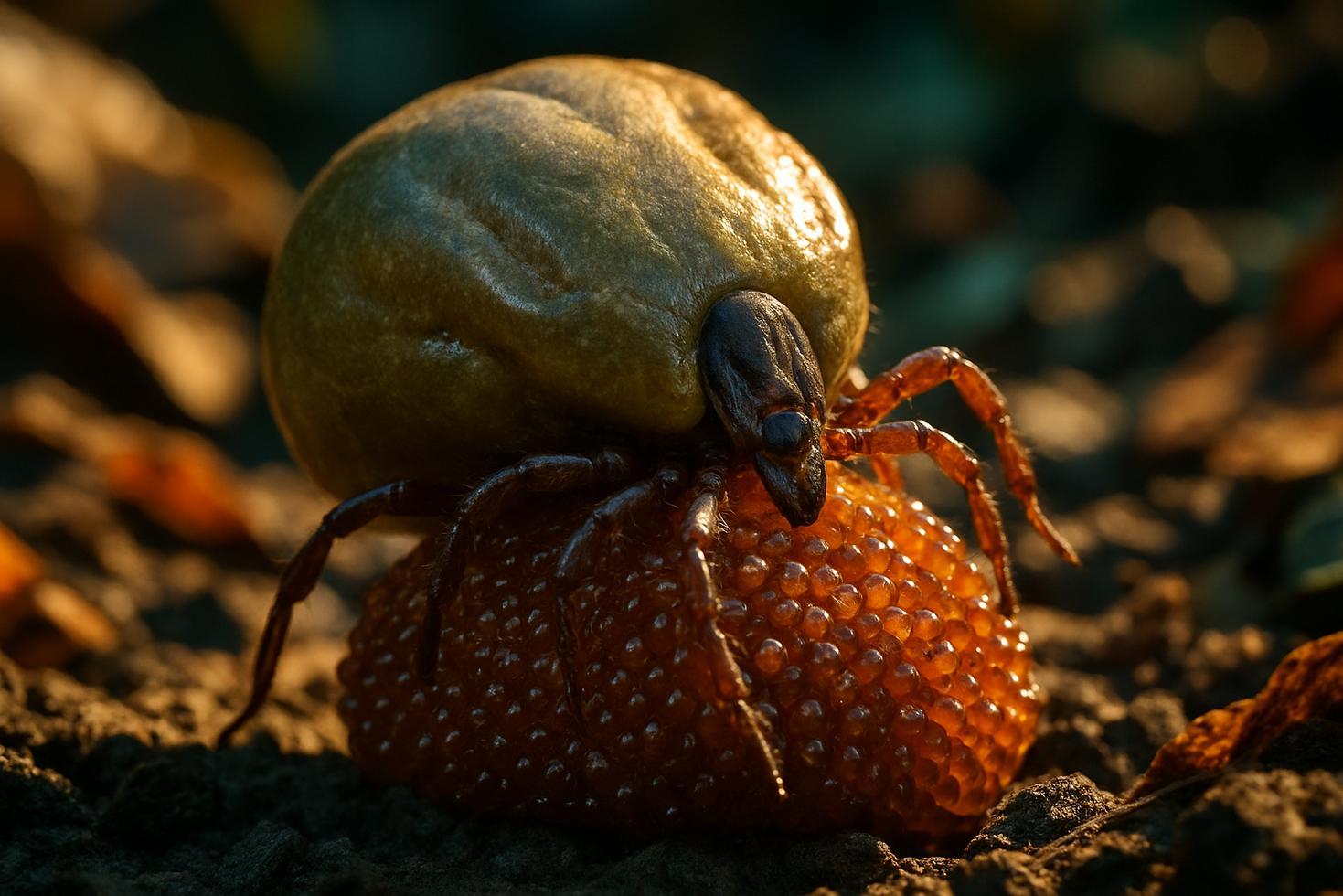
One female hard tick deposits a single batch of up to 10,000 eggs into leaf litter — then dies. That single event, from one tick dropped off a dog, can seed an entire yard.
A female hard tick lays all of her eggs in one batch — thousands at once — then dies. There is no second chance, no second batch, no spreading the effort across seasons. Just one enormous biological event, deposited into leaf litter, and then silence.
What makes this remarkable is the scale relative to the source. A single fertilized female, carried inside on a dog or a pair of pants, can produce anywhere from a few hundred to roughly 10,000 eggs depending on species — all in that single laying event. Maine Cooperative Extension describes it as “a single batch of several thousand eggs.” The Minnesota Department of Health confirms the range as “hundreds to thousands.”
The Mechanism Behind a Single Egg Batch in Hard Ticks
The female converts almost all remaining energy from her final blood meal directly into egg production. One blood meal fuels this entire reproductive event. After laying, she dies — not from exhaustion in any dramatic sense, but because reproduction is, biologically, her terminal stage.
Each egg is independent from the moment it is laid. There is no nest, no maternal care, no shelter built around the clutch.
How the Three-Host Life Cycle Stretches Across Years
Hard ticks in the family Ixodidae don’t stay on a single host. In the common three-host cycle, a tick finds one host as a larva, drops off to molt, finds a second host as a nymph, drops off again, then finds a third host as an adult. That is three separate host-finding events, each one a potential failure point.
The CDC documents that this full cycle takes two to three years to complete — about two years for Ixodes scapularis (the black-legged tick) and roughly three years for Ixodes pacificus (the western black-legged tick). Many ticks die between stages simply because they never find a host.
A yard that looks quiet in November may already be hosting thousands of larvae waiting in leaf litter — hatched from a batch laid weeks earlier, now paused until a host crosses their path.
Why Most Eggs Don’t Survive, but the Math Still Favors the Tick
The majority of eggs and larvae never make it. Host availability, temperature, and humidity all filter the population hard at each stage. But the arithmetic is built for loss. If 10,000 eggs are laid and only one in a thousand reaches adulthood, that is still ten reproductively capable adults.
Those adults — if female and mated — each produce another batch of thousands of eggs. Population growth doesn’t require efficiency. It only requires enough survivors.
The backyard is not a passive space after a single tick drops off. It is a slow-motion sequence that can take three years to fully play out, one stage at a time, one host at a time.
One batch. Years of consequences.
Frequently Asked Questions
How many eggs does a female hard tick lay?
Depending on species, a female hard tick lays one batch ranging from hundreds to roughly 10,000 eggs. All eggs are laid in that single event.
Do hard ticks stay on one host their whole lives?
No. In the common three-host life cycle, a hard tick feeds on three separate hosts across its life, dropping off between each stage to molt.
How long does a hard tick’s full life cycle take?
The CDC documents two to three years as typical, with Ixodes scapularis averaging about two years and Ixodes pacificus about three.
What happens to a female tick after she lays her eggs?
She dies shortly after laying. Egg-laying is the terminal event of her life cycle.