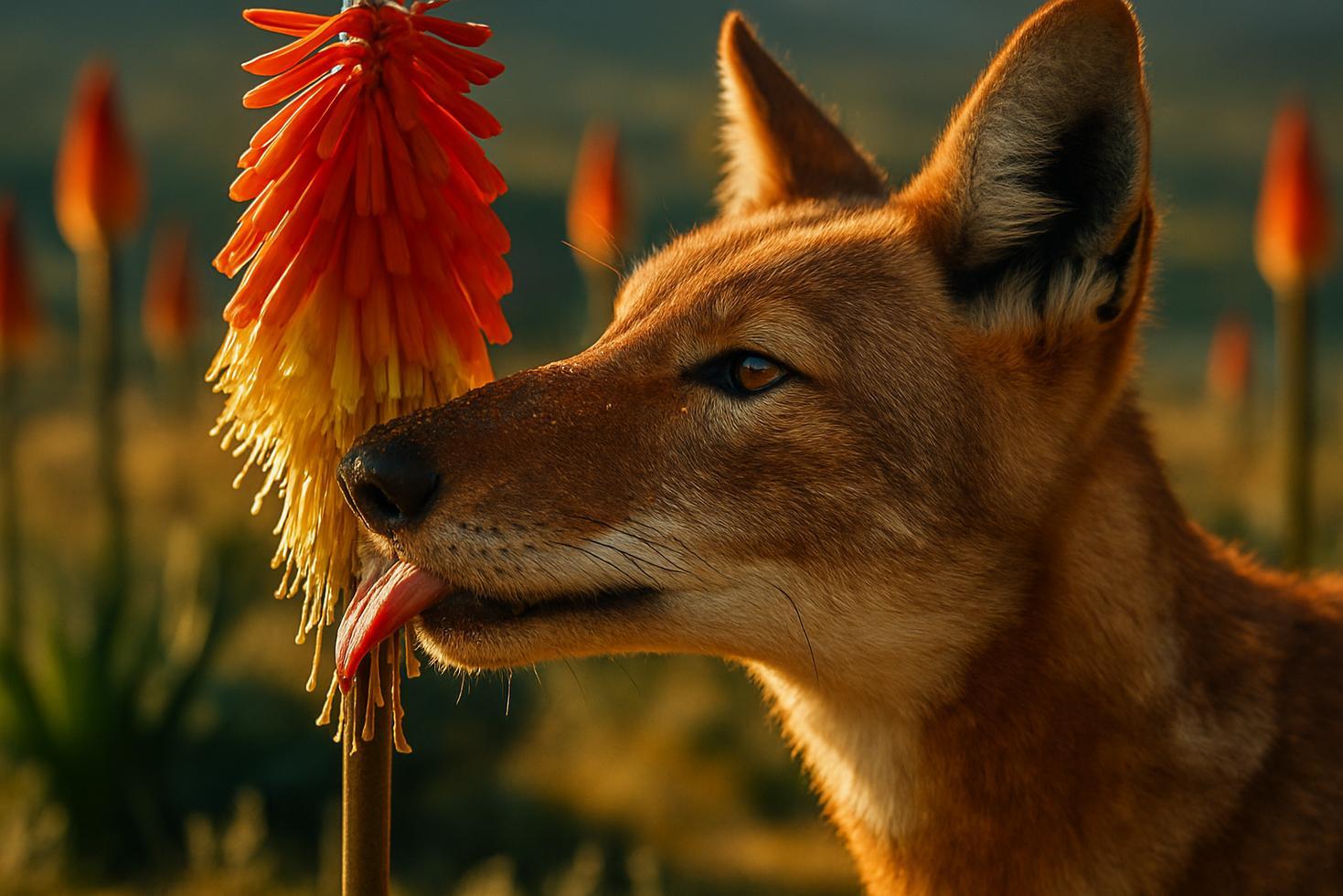
Six wolves from three packs were observed feeding on nectar — and walking away with pollen-dusted muzzles. The apex predator may also be a pollinator.
Ethiopian wolves have been documented feeding on nectar from Kniphofia foliosa, the Ethiopian red hot poker, in the Bale Mountains of southern Ethiopia — the first recorded case of a large carnivore purposefully consuming nectar. A study published in Ecology captured the behavior across six wolves from three separate packs over four days in May and June 2023. That multi-pack pattern rules out a single eccentric individual.
What makes it visually striking is the muzzle. Long and narrow, shaped by evolution for probing rodent burrows, it fits neatly into each tubular bloom. Pollen coats the fur on contact. One wolf was observed visiting 30 flower heads in a single foraging session.
How Ethiopian Wolves Actually Feed on Kniphofia foliosa
The wolves target the lower, more mature flowers at the base of each inflorescence — where nectar accumulates in highest concentration. Observations recorded 3 to 15 seconds per inflorescence. Some individuals spent up to 1.5 hours moving through a single flower patch.
Pollen adhering to the muzzle during feeding is the proposed pollination mechanism. The study authors are careful here: pollen transfer to stigmas was not directly confirmed, and pollination efficiency remains difficult to quantify.
One complicating detail emerged. Some wolves were observed biting flowers rather than licking them. That behavior could damage floral structures and reduce rather than enable pollination.
Why This Finding Is Significant for Ecology
No large carnivore had ever been documented consuming nectar before this study. The assumption — implicit across decades of pollination biology — was that body size alone disqualified animals this large from the role.
The Bale Mountains sit at roughly 3,000–4,400 meters elevation. Kniphofia foliosa blooms there from June through November. Wolves moving between flower spikes at altitude may fill a pollination function that no insect in that ecosystem covers at the same spatial scale, though this remains the authors’ interpretation rather than a measured outcome.
The behavior appearing across multiple packs suggests it is learned or culturally transmitted within the species, not an individual anomaly.
Frequently Asked Questions
What flower does the Ethiopian wolf feed on?
Kniphofia foliosa, commonly called the Ethiopian red hot poker — a tall, flame-colored alpine plant native to the Bale Mountains of Ethiopia.
Has the Ethiopian wolf been confirmed as a pollinator?
Not definitively. The study documented pollen on wolf muzzles but did not confirm deposition on stigmas or successful fertilization.
When does nectar feeding occur?
During the plant’s main blooming season, reported as June through November, with some field observations beginning in May.
Is this behavior found in more than one wolf?
Yes. The study recorded it across six wolves from three separate packs, indicating it is not an isolated individual behavior.