
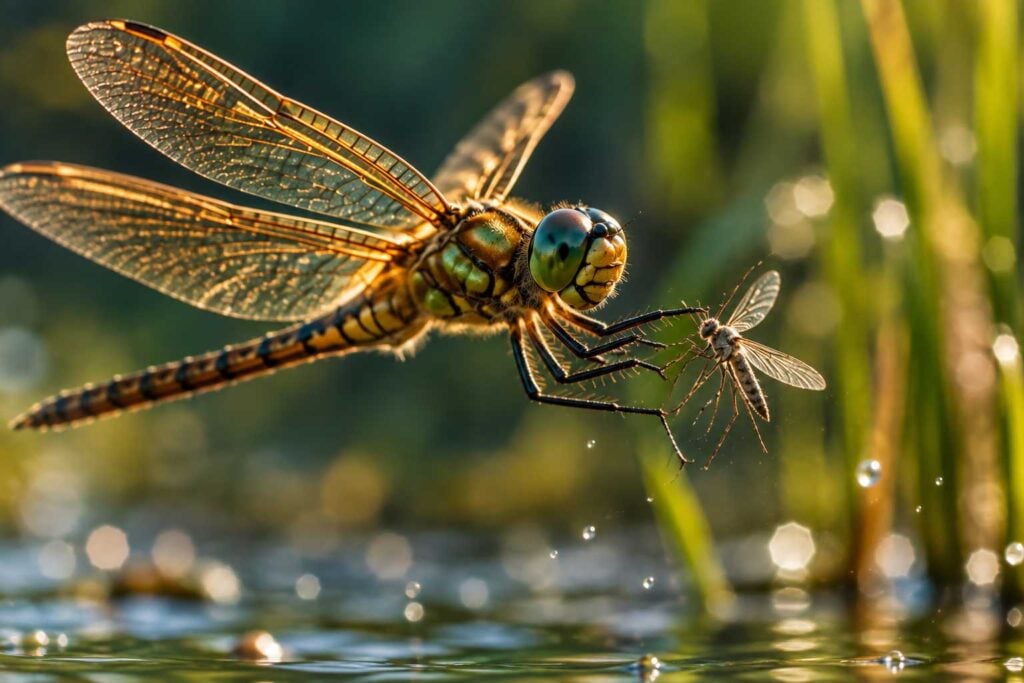
A dragonfly doesn’t follow its prey through the air. It calculates where that prey is going to be and flies straight to that empty point in space.
It arrives before its target does. That shift, from chasing to predicting, is a big part of why dragonflies are among the most effective aerial hunters studied in the insect world.
Quick Answer
- Dragonflies use predictive interception, not pursuit. They target where prey will be, not where it currently is.
- A 2013 PNAS study found dragonflies intercept prey in midair with about a 95% success rate, driven by a set of just 16 specialized neurons.
- Those 16 “target-selective descending neurons” (8 pairs) track prey direction across a full 360 degrees. They connect almost directly to the wing muscles.
- A 2015 Nature study found a dragonfly’s steering is mostly model-driven — it plans its turns in advance. It only reacts visually when prey does something unexpected.
- The dragonfly’s head locks onto the target using a high-resolution patch of its compound eye. Meanwhile, the body steers independently toward the intercept point.
The 16 Neurons That Map the Sky
In 2013, researchers studying dragonflies identified 16 neurons that do almost all the work of aiming a hunt. The neurons are arranged in eight matched pairs. Each pair is tuned to a different slice of direction.
Together, they cover the full 360 degrees around the dragonfly. Instead of firing off a simple “something moved over there” signal, this small neuron population encodes the target’s direction and trajectory as a group. Researchers call this signal a population vector.
That signal runs close to straight from the eyes to the wing muscles, with very little in between. It’s a short, fast circuit. That’s part of why a dragonfly can compute an intercept course in a fraction of a second.
The same 2013 study, published in the Proceedings of the National Academy of Sciences (PNAS), reported that dragonflies using this system intercept their prey with roughly a 95% success rate. That’s a real, peer-reviewed figure, not an internet estimate.
Predicting, Not Reacting: What the 2015 Nature Study Found
A separate study tracked the head and body movements of hunting dragonflies in fine detail. It was published in Nature in 2015 by researchers funded through the Howard Hughes Medical Institute.
It found that most of a dragonfly’s in-flight steering isn’t a reaction to what the prey just did. Instead, the dragonfly builds an internal model — a kind of running prediction — of both its own body dynamics and where the prey is headed.
It steers off of that model. Vision mostly kicks in for one job: catching sudden, unexpected moves the model didn’t already account for.

The head and body work as two separate systems here. The head rotates to keep the prey’s image locked onto a small, extra-sharp patch of the eye called the dorsal acute zone.
That patch is packed with far more visual units per degree than the rest of the compound eye. The body, meanwhile, rotates independently to line up with the prey’s flight path. Both happen at once, without one throwing off the other.
The Forward-Focus Mechanism (2017 Study)
A follow-up study published in eLife in 2017 looked at what’s actually happening in the visual system during a hunt. It found something specific: a small zone of heightened neural sensitivity forms just ahead of the target’s current position, not on top of it.
When a target briefly passed behind an obstacle, that zone of heightened sensitivity kept moving forward in the direction the target had been traveling.
It was as if the dragonfly’s visual system were still tracking a target it could no longer see. That’s a genuine, measured predictive-tracking mechanism, not a metaphor.
Vision and Flight Built for the Job
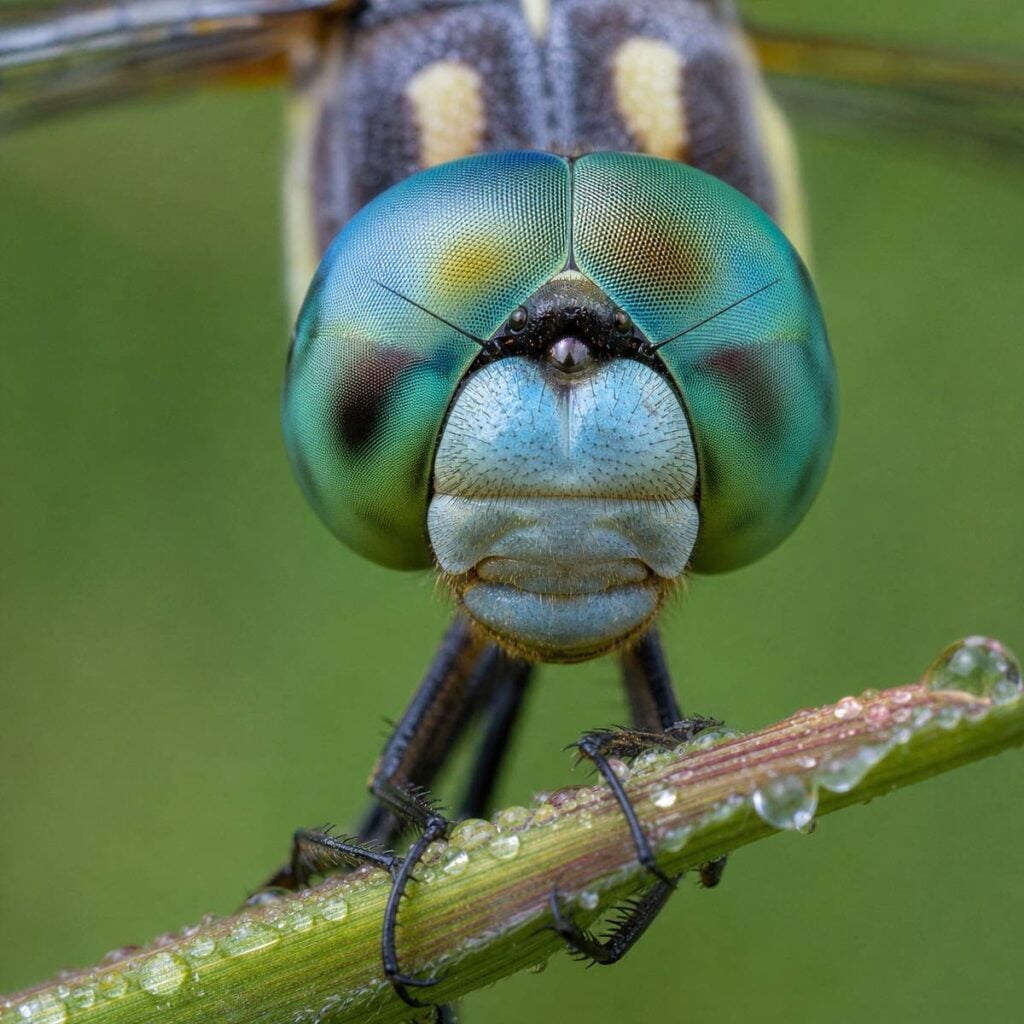
None of this works without the hardware to back it up. A dragonfly’s compound eyes are built from tens of thousands of individual lenses and give it close to a full 360-degree field of view.
That makes it extremely hard to approach unseen. Its four wings are controlled independently of one another, letting it hover, reverse, and change direction almost instantly. That’s the kind of fine control needed to hit a moving intercept point rather than just fly fast in a straight line.
Closing
The unusual part of dragonfly hunting isn’t raw speed. It’s timing. The interception course gets calculated before the moment fully arrives. It relies on a neural shortcut small enough to fit in an insect’s brain and fast enough to beat the prey to the spot.
Sources
- Gonzalez-Bellido et al., “Eight pairs of descending visual neurons in the dragonfly give wing motor centers accurate population vector of prey direction,” PNAS, 2013
- Mischiati et al., “Internal models direct dragonfly interception steering,” Nature, 2015 (PubMed)
- HHMI press release on the Mischiati et al. Nature study
- Phys.org coverage of the same study
- Wiederman et al., “A predictive focus of gain modulation encodes target trajectories in insect vision,” eLife, 2017
- NC State Extension Entomology — Dragonfly
- Natural History Museum (UK) — “Dragonflies: The Ultimate Hunters”
Frequently Asked Questions
How accurate are dragonfly intercepts?
A 2013 study in the journal PNAS reported that dragonflies intercept their prey in midair with a 95% success rate. That figure comes from a peer-reviewed study of the neural circuit behind dragonfly targeting, so it is a published research result rather than a rough internet estimate.
What are the 16 neurons in a dragonfly’s hunting system?
They are target-selective descending neurons, arranged as eight pairs. Together they code the direction of the target across 360 degrees, and the 2013 PNAS study describes them as giving the wing motor centers a population vector of prey direction. In plain terms, the group shares one direction signal rather than each neuron reporting alone.
Do dragonflies chase prey or predict where it will go?
They mostly predict. The 2015 Nature study found that model-driven control, built on models of the dragonfly’s own body and of prey motion, underlies the bulk of interception steering. Vision is used for reactions to unexpected prey movements, so the dragonfly heads for the intercept point instead of trailing behind its target.
Can a dragonfly keep tracking prey that disappears behind something?
Its visual system appears to. In the 2017 eLife study, a small zone of heightened neural sensitivity formed just ahead of the target. When the target briefly passed behind an obstacle, that zone kept moving in the direction the target had been traveling, as if still following something it could no longer see.
How does a dragonfly’s body help it hunt?
Its compound eyes are built from tens of thousands of individual lenses and give close to a full 360-degree field of view. Its four wings are controlled independently, which lets it hover, reverse, and change direction almost instantly. That fine control is what a hunting dragonfly needs to reach a moving intercept point.