
Cordyline ‘Red Sister’ is one of the many named cultivars of the ti plant, Cordyline fruticosa, also called the Hawaiian ti plant or good luck plant. Gardeners grow it for one reason: those bold red, pink and burgundy leaves that add a tropical pop to a patio, a garden bed or a bright room.
Here’s the first thing to get straight. Red Sister is not a dracaena. It’s a Cordyline, a member of the asparagus family (Asparagaceae). The two get mixed up all the time, and we’ll show you how to tell them apart below.
The species is a broadleaf evergreen shrub. Its home range is described a little differently from guide to guide: tropical Southeast Asia, eastern Australia and some Pacific islands, including Hawaii, or Australia and the Western Pacific islands.
Red Sister Cordyline Quick Care Tips
- Botanical name: Cordyline fruticosa ‘Red Sister’
- Common names: Ti plant, Hawaiian ti plant, good luck plant, Red Sister ti
- Old names (synonyms): Cordyline terminalis, Dracaena terminalis, Convallaria fruticosa, Terminalis fruticosa
- Pronunciation: kor-di-LY-nee froo-tih-KOH-sah
- Family: Asparagaceae (the asparagus family)
- Hardiness zones: 9B to 11B (some listings say 10 to 12)
- Size (species): 3 to 10 feet tall outdoors; more often 3 to 6 feet as a houseplant
- Light: Bright, indirect light indoors; avoid harsh afternoon sun
- Temperature: 65 to 85°F indoors; never below 50°F, and a 65°F winter minimum is safer; avoid cold drafts
- Humidity: 40 to 60% indoors; it prefers high humidity
- Soil: Well-drained, acidic potting mix
- Water: Moist but not wet; water less from fall to late winter
- Watch for: Fluoride sensitivity (brown tips), mealybugs, scale, spider mites, leaf spot
- Propagation: Stem cuttings, stem sections (ti logs), air layering
- Safety: Toxic to dogs, cats and horses if eaten; sap can irritate skin
Is Red Sister a Dracaena?
No. Red Sister is a Cordyline, and Dracaena is a different genus. The mix-up is understandable. One of the ti plant’s old botanical names is Dracaena terminalis, and “common dracaena” and “dracaena” still turn up among its common names. The ti plant is often confused with Dracaena fragrans.
You can tell them apart with two quick checks from NC State Extension:
- Leaf stalks: Cordyline leaves have grooved petioles (leaf stalks). Dracaena leaves have none.
- Roots: Cordyline roots are white. Dracaena roots are orange or yellow.
Older references also file the ti plant under other families, such as Agavaceae and Laxmanniaceae. Current listings place it in Asparagaceae.
If a true dracaena is what you’re after, see our guides to Dracaena varieties and the red-edged Dracaena marginata.
Red Sister Cordyline Care
Size and Growth
Ti plants come in a wide range of leaf colors: green, red, burgundy, pink, purple and variegated, depending on the cultivar. Red Sister is one of the red-to-pink types. There is no single authority that names ti plants, though, so cultivar names can vary from place to place.
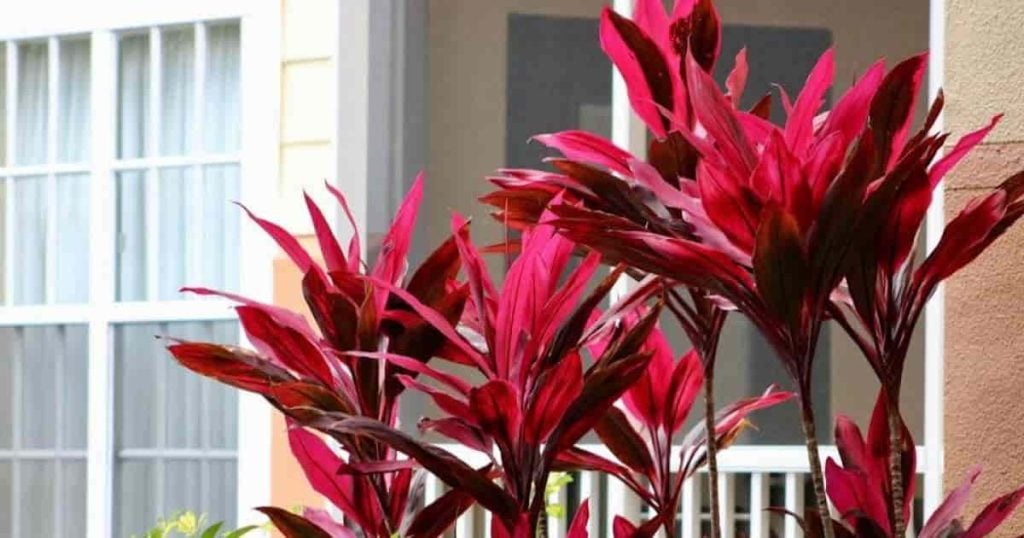
How big does it get? That depends on where it grows. The species is listed at 3 to 10 feet tall and 2 to 4 feet wide, with leaves 8 to 18 inches long, though other listings give 9 to 15 feet tall, with leaves up to 30 inches long and 6 inches wide. As a houseplant, it more often grows 3 to 6 feet tall. No separate size is published for Red Sister.
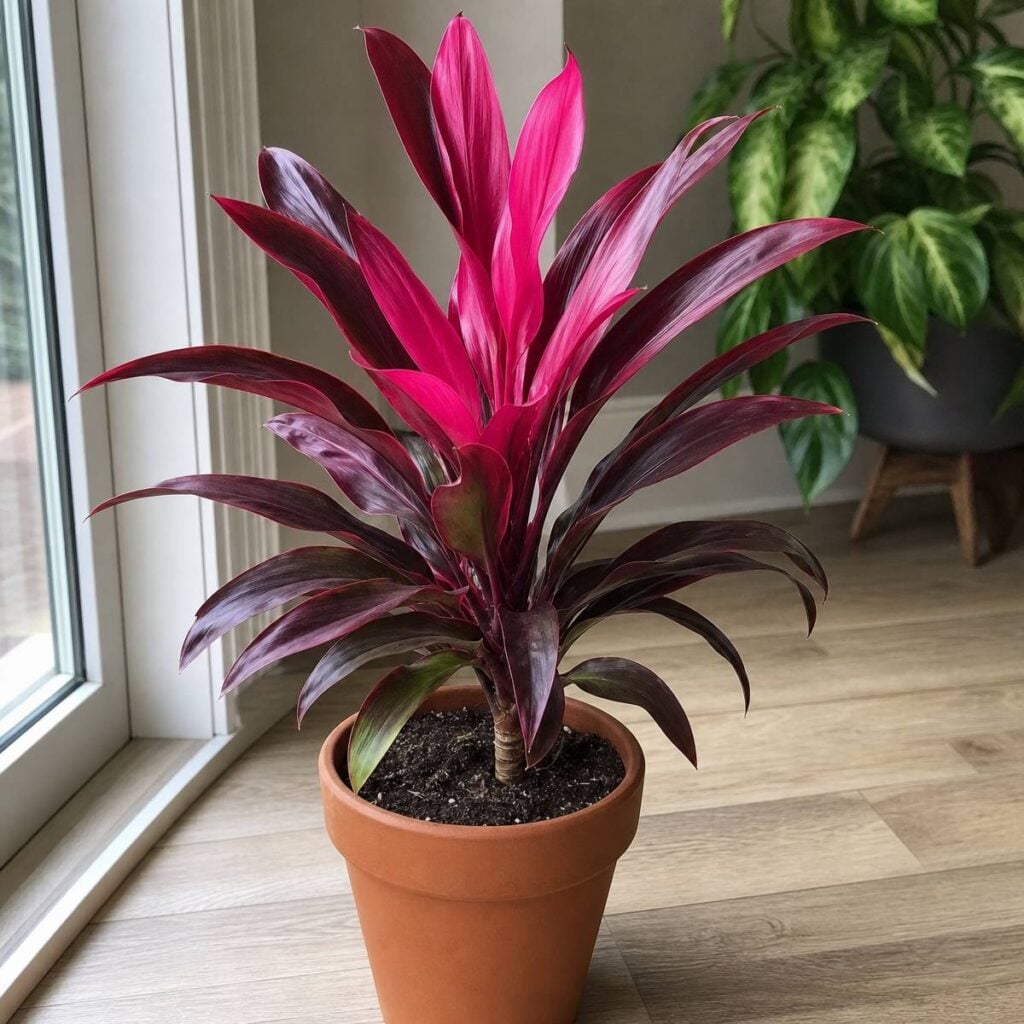
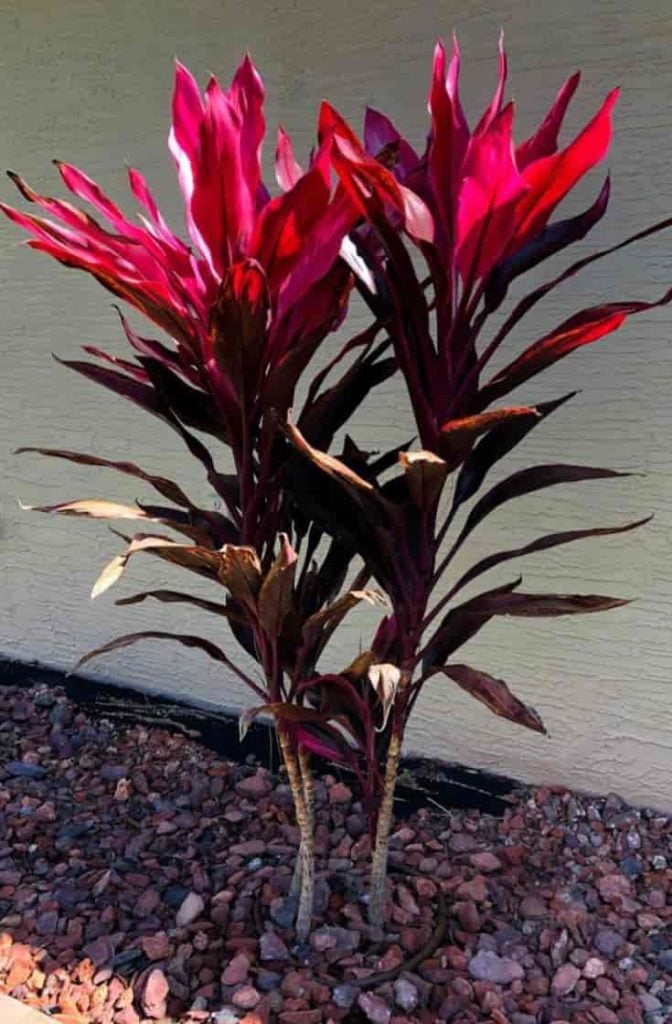
The plant has an upright, open habit, with clumping stems and leaves clustered in spirals at the tips. As it ages, the older lower leaves yellow and drop, leaving rings of leaf scars on the stem. This is normal.
In a container, that upright shape makes Red Sister a natural “thriller” in a thriller-filler-spiller combination. Set it near the center of the pot and surround it with lower plants and ones that spill over the edge. Use a pot with drainage holes.
Flowering and Fragrance
Outdoors in warm climates, ti plants bloom on a branched flower stalk about a foot long. The small, fragrant flowers appear in spring or summer and come in white, pink, lavender or yellow, followed by red berries.
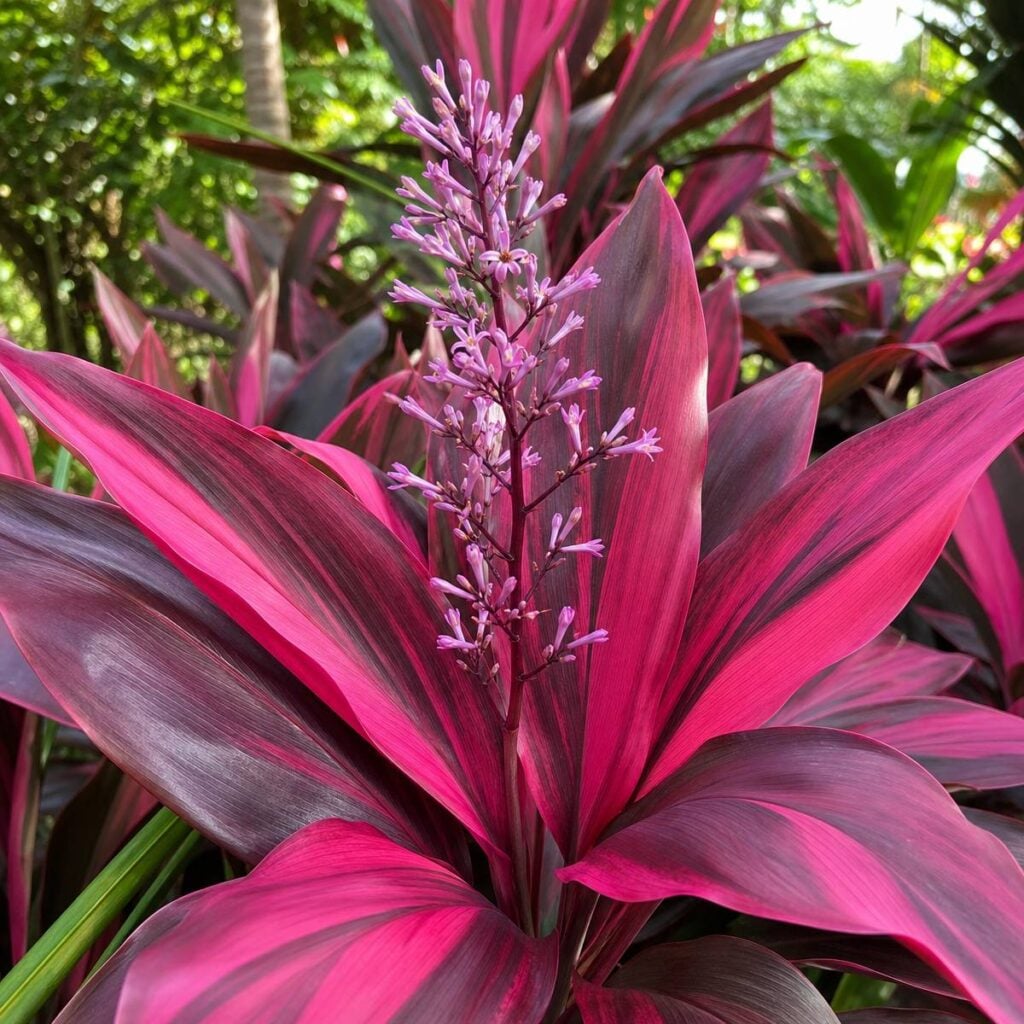
Indoors, don’t count on flowers. Potted indoor plants rarely flower or fruit. The leaves are the real show anyway.
Light
Bright light brings out the best color. Ti develops its best leaf color in bright light and needs about 4 hours of direct sun or bright, indirect light indoors. A spot within 4 to 8 feet of a large south-, east- or west-facing window works well. Bright, indirect light keeps the foliage colors bright.
Too little light has a cost. In very low light, new growth gets stretched and poor in color, and red cultivars grown in heavy shade tend to make greener leaves. Too much harsh sun is a problem too. The Missouri Botanical Garden says too much direct afternoon sun can scorch the leaves, and brightly colored cultivars burn easily in full sun.
Outdoors, the ti plant grows in full sun, partial shade or full shade. If you move a plant from shade into sun, UF/IFAS Extension Charlotte County advises doing it gradually over several days to weeks, or the leaves will sunburn. Ti is only fairly wind-tolerant and needs a windbreak in windy spots.
Temperature, Humidity and Hardiness
Indoors, aim for 65 to 85°F, humidity of 40 to 60%, and a spot away from cold drafts. The plant does best at 65 to 95°F and does not tolerate temperatures below 50°F; a stricter rule of thumb is a winter minimum of 65°F.
Humidity matters more than you might think. Ti plants prefer high humidity, a humidifier may be needed indoors, and the leaf tips turn brown if the air is too dry. Low light, low humidity and hot, dry air can cause leaf loss.
For growing outdoors, zone ranges vary: 9B to 11B in some listings, 10 to 12 in others. The plant does best in zone 10; in zone 9b, keep it in containers so you can move it to shelter when needed. Cool weather brings out the strongest leaf color, from November through May in Charlotte County.
Watering
Aim for evenly moist, never soggy. Keep the well-drained mix moist but not wet and avoid extremes, because excessive drying between waterings causes tipburn and dead leaf margins. Don’t overwater, since overwatering leads to disease.
Ease off in the cool months. Let the plant dry out a bit between waterings and water less from late fall to late winter. In other words: consistently moist soil from spring to fall, then a resting period with less water.
Water the soil, not the leaves. Avoiding overhead watering is one of the controls for leaf spot and stem rot.
Fluoride and Brown Leaf Tips
If your Red Sister’s leaf tips are turning brown, check the water. University of Hawaii Extension (CTAHR) says ti plants are highly sensitive to fluoride from air, water, potting media or fertilizer. The damage shows up as tipburn and dead leaf margins, then mottling toward the center of the leaf. It recommends water, potting media and fertilizers low in fluoride, with irrigation water under 0.25 ppm. Fluoride toxicity is a well-known ti plant problem.
Dry air and uneven watering cause brown tips too, so rule those out. Our guide to brown tips on houseplants walks through every cause.
Soil and Fertilizer
Plant in a rich, well-drained mix. Ti grows best in fertile, moist, well-drained, acidic soil high in organic matter, with a pH of 5.5 to 6.5. For pots, use a well-drained loamy soil or a peat-based potting mix.
Keep it away from salt. The ti plant’s salt tolerance is poor, and it is intolerant of salt spray and prolonged drought. That matters if you garden near the coast.
For feeding, fertilizing several times a year helps the plant keep its colors. Slow-release fertilizers work best for potted ti; outdoors, use an occasional general garden fertilizer at 3- to 4-month intervals. Follow the product label for amounts. If you use a liquid fertilizer, rinse it off the leaves so it doesn’t damage the emerging leaf.
Repotting and Grooming
Potted ti plants may be moved into larger containers as they grow. Go up one pot size at a time, into a fresh, well-drained mix.
Grooming is simple. Cut or pull off lower leaves that turn yellow or brown or show leaf spots, and prune to control size. A tall, leggy plant can be rejuvenated by cutting the stems back to 6 inches above the soil, so new shoots grow lower on the stem.
How To Propagate Cordyline Red Sister
There are four ways to propagate ti: stem sections, tip (terminal) cuttings, seeds and air layering. To keep Red Sister’s color, stick to cuttings. Seedlings vary widely in size, leaf color and shape, and named cultivars are propagated vegetatively.
Tip cuttings: A cluster of leaves with about 6 inches of stem roots quickly and makes a well-shaped plant in 4 to 6 months.
Stem sections (ti logs): Cut a bare stem into pieces 1 inch long or longer. Set them upright with three-fourths of the length buried, or lay them on their side with about 1/4 inch of the stem’s thickness covered, in perlite, vermiculite or a peat moss and sand mix. Keep them moist and in partial shade. Cuttings root in 2 to 4 weeks, and a section laid on its side can sprout several plants. A rooting hormone is not necessary.
Rooting in water: Use a cutting at least 6 inches long, with about an inch of the end in water. Change the water occasionally, and pot the cutting up once it has a strong root system, before the roots get very long.
Air layering: An air-layered branch takes a couple of months to root.
Seeds: Fresh seeds germinate in 2 to 6 weeks when sown about 1/4 inch deep and kept moist and warm. Just remember the seedlings won’t all look like their parent.
Cordyline Red Sister Pests and Diseases
Check the undersides of leaves and the leaf bases now and then for aphids, scale insects, spider mites, fungus gnats, thrips, mealybugs and nematodes.
Try these home-scale controls:
- Mealybugs: Dab them with a cotton swab soaked in rubbing alcohol, pick them off, or wash the plant with soapy water and a soft brush or cloth.
- Scale: Wash with soapy water, remove with an alcohol-soaked swab, or use a horticultural oil.
- Spider mites: A forceful spray of water helps keep populations down.
- Broad mites: Ultra-fine oil, insecticidal soap or neem may be used.
- Aphids: Insecticidal soap, the safest and most effective control.
Whatever you spray, read the label first. The pesticide label is the law.
For diseases, provide good air circulation and avoid overwatering or soggy soil. Here are three to know:
- Cercospora leaf spot: Rectangular yellow to brown spots between the leaf veins. Water early in the day, avoid overhead watering, space plants out and remove diseased leaves.
- Fusarium stem and root rot: Mushy brown roots and a soft rot at the base of the stem, often with a purplish or reddish edge. Remove and destroy affected plants.
- Bacterial stripe: Long, thin, water-soaked stripes between the veins that darken over time.
Is the Plant Toxic or Poisonous?
Yes, for pets. The ASPCA lists the ti plant as toxic to dogs and cats. It names saponins as the toxic principle and lists vomiting (occasionally with blood), depression, loss of appetite, drooling and dilated pupils (in cats) as signs. It is toxic to horses too.
For people, the toxicity is rated low, but eating the plant can cause stomach upset. Supervise children and pets around the plant and wear gloves when handling it because of the risk of skin irritation. Saponins in the sap can also cause contact dermatitis. If you think a pet has eaten some, call your veterinarian or the ASPCA Animal Poison Control Center.
Uses for Cordyline Red Sister
Red Sister is all about foliage. Use the ti plant as a specimen or accent, in mass plantings, in containers, or as a houseplant in bright indirect light. Pair it with other bold tropicals such as crotons, gingers, heliconias and philodendrons, softened by ferns or cast iron plant, over a base of liriope or mondo grass. It also works for hedges, screens and foundation plantings, with plants set 2 to 3 feet apart for massing.
The ti plant also has deep roots in Hawaiian culture. Early Polynesians believed the plant had divine power and planted it around homes to ward off evil and bring good fortune. Its leaves are still used to wrap food for cooking and to make hula skirts, and they have been used for thatch, rain capes, sandals and even sleds. The plant is still believed to bring good luck.
Want to know more about the species? See our guides to Cordyline fruticosa and Hawaiian ti plant care.
Do you grow a Red Sister? Tell us where yours lives and how its color holds up.
Frequently Asked Questions
Is Cordyline Red Sister a dracaena?
No. Red Sister is a cultivar of Cordyline fruticosa, the ti plant, in the asparagus family, and Dracaena is a different genus. The two are often confused. Two quick checks: cordyline leaves have grooved leaf stalks and white roots, while dracaena leaves have no leaf stalks and dracaena roots are orange or yellow.
How much light does a Red Sister ti plant need?
Bright light gives the best color. Aim for about 4 hours of direct sun or bright, indirect light indoors, within 4 to 8 feet of a large south-, east- or west-facing window. Too much direct afternoon sun can scorch the leaves, and red cultivars grown in heavy shade tend to turn greener.
Why are my Red Sister’s leaf tips turning brown?
The usual suspects are fluoride, dry air and uneven watering. Ti plants are highly sensitive to fluoride in water, potting mix and fertilizer, and excessive drying between waterings causes tipburn. The tips also brown when the air is too dry. Our brown tips guide covers each cause.
Is the Red Sister plant toxic to cats and dogs?
Yes. The ti plant is toxic to dogs and cats because of saponins, with signs such as vomiting, depression, loss of appetite, drooling and, in cats, dilated pupils. It is toxic to horses too, and gloves are a good idea when handling it because of the risk of skin irritation. Keep it out of reach of pets and children.
How do you propagate Cordyline Red Sister?
Use cuttings to keep its color. Tip cuttings with about 6 inches of stem root quickly, and stem sections an inch or longer root in 2 to 4 weeks in a moist mix, without rooting hormone. Plants grown from seed vary widely in leaf color and shape.