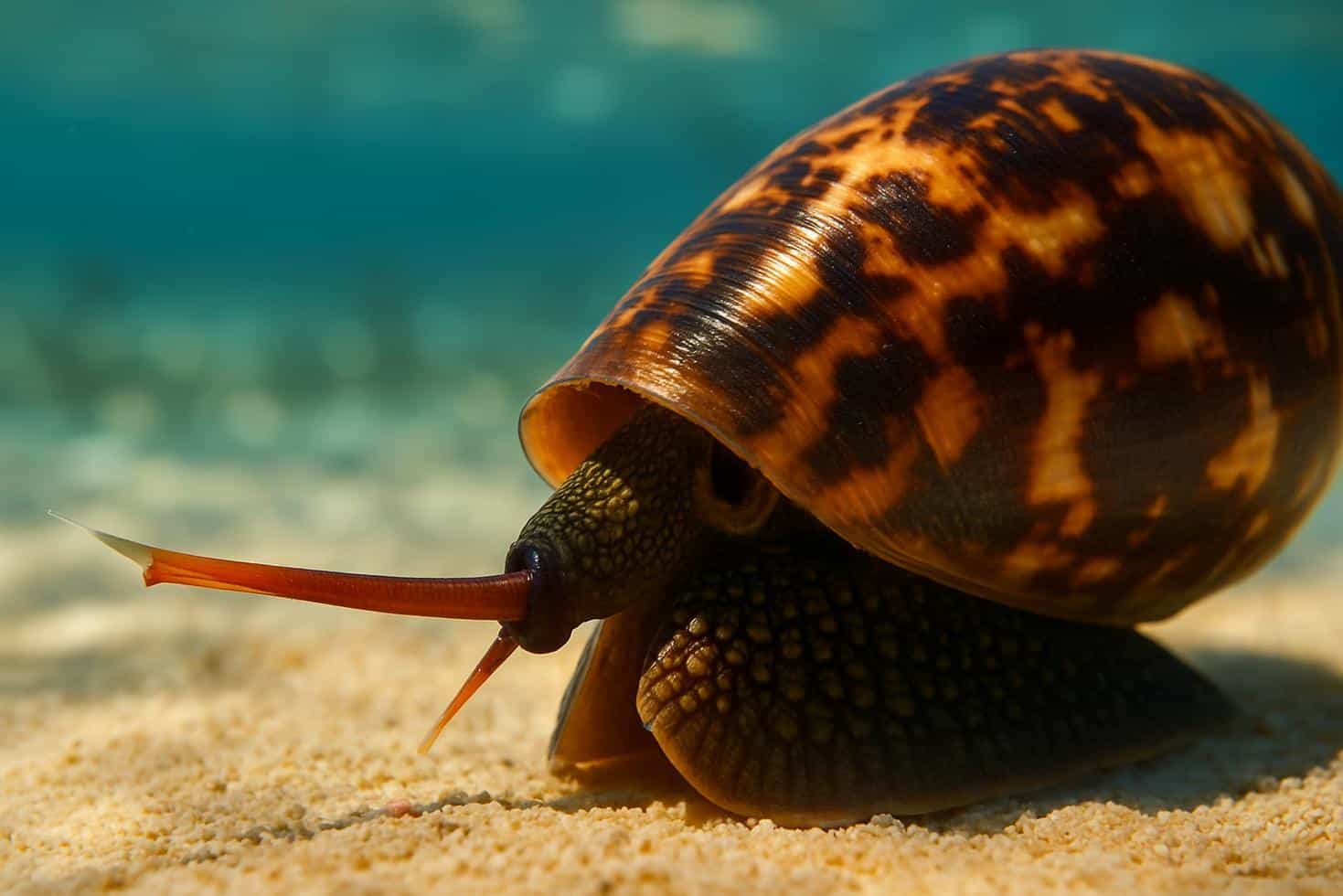
A 25-amino-acid peptide from Conus magus blocks N-type calcium channels at the spinal cord — no opioid receptors touched, no reward pathway triggered, no withdrawal syndrome.
A compound borrowed directly from cone snail venom blocks pain signals at the spinal cord without activating any part of the brain’s reward system. That single mechanical distinction is why ziconotide — derived unchanged from Conus magus — produces no physical dependence and no withdrawal syndrome, something no opioid can claim.
The snail itself needed none of that. It fires a hollow, barbed radular tooth through an extensible proboscis in tens to hundreds of milliseconds, injecting venom before a fish can react. The peptide in that venom became one of the most potent analgesics ever characterized — not through redesign, but through direct borrowing.
What the Cone Snail’s Venom Actually Does to a Nerve
Each cone snail venom is a mixture of tens to hundreds of distinct peptides called conotoxins. They are small — roughly 10 to 30 amino acids — and stabilized by multiple disulfide bonds that lock them into precise three-dimensional shapes.
In fish-hunting species like Conus magus, one class of conotoxin targets N-type voltage-gated calcium channels (Cav2.2) on presynaptic nerve terminals. Blocking Cav2.2 cuts calcium influx that would otherwise trigger vesicular release of glutamate and substance P — the neurotransmitters that carry nociceptive signals forward. The fish goes limp in seconds.
How Ziconotide Differs from Morphine at the Receptor Level
Morphine binds μ-opioid receptors distributed across both spinal cord and brain. That activation modulates pain, but it also engages dopaminergic reward circuitry — the same pathway that drives tolerance, dependence, and withdrawal.
Ziconotide, the synthetic form of ω-conotoxin MVIIA, does not bind opioid receptors. It acts only on Cav2.2 channels in the dorsal horn of the spinal cord. No dopaminergic reward pathway involvement means no physical dependence forms and no withdrawal syndrome follows cessation.
Clinical and regulatory reviews — including FDA and EMA assessments — confirm the absence of opioid-type tolerance with ziconotide. The trade-off is a narrow therapeutic window: dizziness, confusion, and psychiatric symptoms can emerge at higher doses, which limits how it is used clinically.
The molecule was already finished when researchers found it. Forty years of medicinal chemistry chasing a non-addictive analgesic, and the answer was sitting on a reef inside a shell.
A snail solved it first.
Frequently Asked Questions
How does ziconotide block pain?
It binds N-type voltage-gated calcium channels (Cav2.2) on presynaptic terminals in the spinal cord’s dorsal horn, preventing calcium influx and blocking release of glutamate and substance P.
Why doesn’t ziconotide cause addiction like morphine?
Ziconotide does not bind opioid receptors and does not engage the brain’s dopaminergic reward pathway, so no physical dependence or withdrawal syndrome develops.
What snail does ziconotide come from?
It is derived from ω-conotoxin MVIIA, originally isolated from Conus magus, a fish-hunting marine cone snail.
What are the downsides of ziconotide?
Its therapeutic window is narrow. Higher doses produce CNS side effects including dizziness, confusion, and psychiatric symptoms, which restricts clinical use.