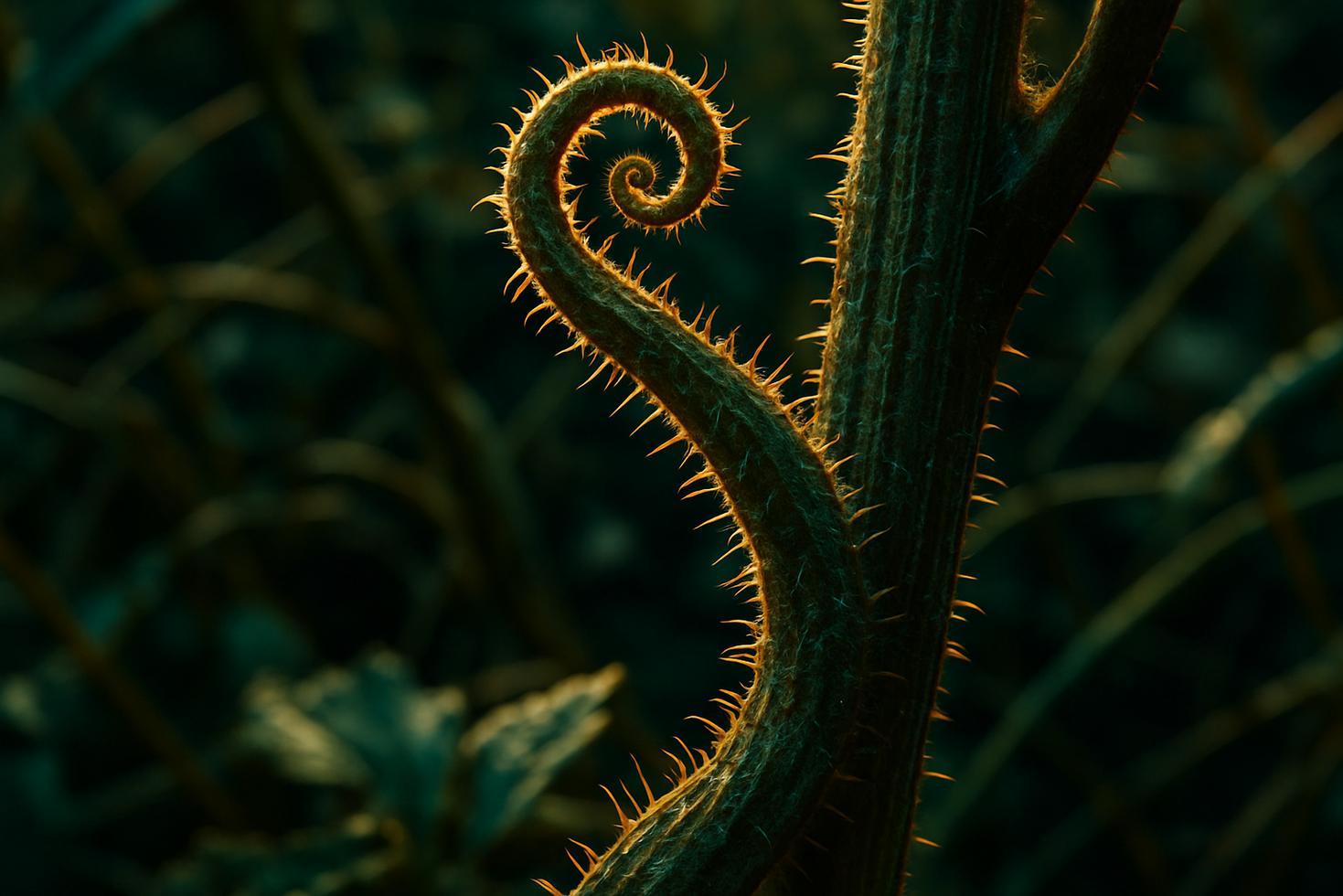
Hundreds of backward-curved hooked hairs, too small to see clearly with the naked eye, let cleavers hitch rides across continents — and that same sticky surface was pressed flat against cuts and burns in European folk medicine for generations.
Galium aparine — cleavers, goosegrass, sticky weed — grips fabric, fur, and feathers using rows of tiny backward-facing hooked hairs covering its stems and leaves. That physical mechanism is the whole survival story of this plant. It spreads not by wind or explosion but entirely by catching a ride on whatever moves past.
The hooks are not decorative. Each one curves backward at the tip, so forward motion by an animal or passing human drives the hook deeper into fibers rather than releasing it. An animal brushes a hedgerow, and by the time it reaches new ground, cleavers has traveled with it.
How the Hooked-Hair Adhesion Mechanism Actually Works in Galium aparine
The stickiness of cleavers comes entirely from structure, not chemistry. Backward-curving hooks on stem and leaf hairs catch onto looped fibers in fabric and the coarser guard hairs of animals. This is the same geometric principle George de Mestral observed in burdock burrs in 1941 and eventually formalized as Velcro — though cleavers had been running this mechanism long before that.
The plant uses attachment for two purposes simultaneously: clinging to other vegetation to climb upward toward light, and clinging to animals to move seeds to new locations.
Traditional Poultice Use of Cleavers for Wounds and Burns
Folk healers across Europe pressed crushed cleavers stems directly onto light wounds and burns as a cooling poultice. Wikipedia’s entry on Galium aparine and several herbal sources confirm this external use, describing poultices and washes applied to skin ailments. Herbal sources also note astringent and anti-inflammatory properties in traditional contexts, though these claims come from folk and blog sources rather than peer-reviewed studies.
One preparation found in traditional herbal records is a cold infusion steeped 24 to 48 hours, used as a wash rather than a heated tea. The same sticky surface that grips a jacket sleeve was, in that context, holding the plant flat against broken skin.
The mechanism doing both jobs — dispersal and wound contact — is identical. One structure, two applications.
Habitat: Where Cleavers Actually Grows
Galium aparine is a climbing annual. It thrives in shady hedgerows, damp gardens, and disturbed ground, growing along the ground or scrambling upward over other plants using its hooked hairs for purchase. The Caption_Text’s claim that cleavers spread to Asia and North America is plausible given its cosmopolitan distribution, but the supplied research does not verify specific regional spread history, so it stays unconfirmed here.
Pat has spent decades pulling cleavers off field gear without giving it much thought. Knowing the hooks are structural, not chemical, makes the whole plant harder to dismiss as just an annoyance. It’s a dispersal machine that doubles as a first-aid kit — and it built both tools from the same curve.
Frequently Asked Questions
What makes cleavers so sticky?
Backward-facing hooked hairs on the stems and leaves catch onto fibers and fur, gripping tighter as the surface moves forward.
Was cleavers actually used medicinally?
Yes — folk healers in Europe used crushed cleavers as a poultice on light wounds and burns, and as a skin wash, though this is documented in folk and historical sources, not clinical studies.
How is cleavers prepared as a cold infusion?
Traditional preparation involves steeping the plant in cold water for 24 to 48 hours, then using the liquid as a topical wash.