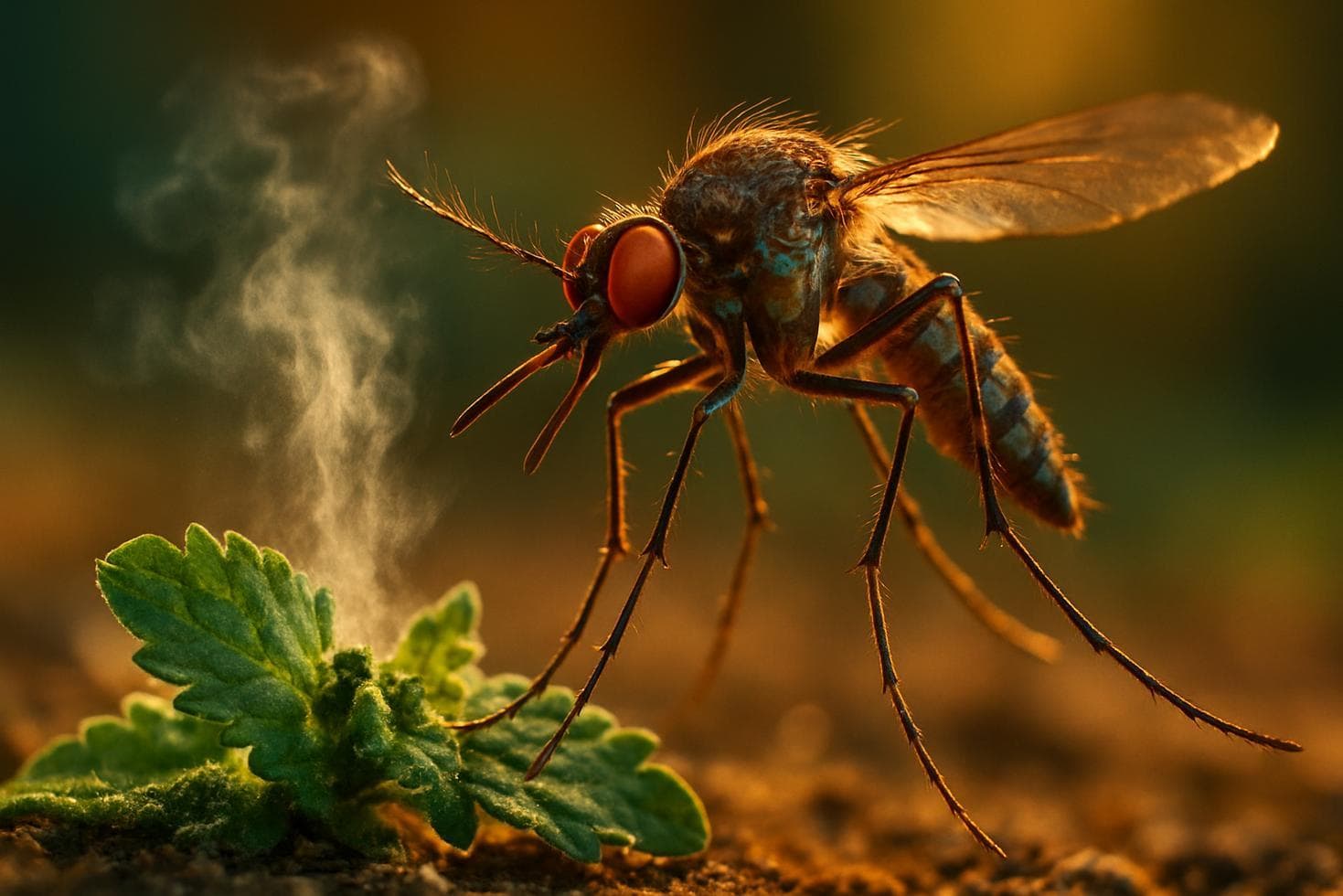
Nepetalactone makes up to 80% of catnip extract — and it fires a mosquito’s pain sensor the same way heat and harsh chemicals do. The compound that makes cats euphoric is the same one that sends mosquitoes in the opposite direction.
Catnip (Nepeta cataria) repels mosquitoes by activating TRPA1, an irritant receptor in the insect’s sensory system that normally fires in response to heat, acid, and harsh chemicals. That single mechanism is what connects feline euphoria to mosquito avoidance — one compound, two completely opposite reactions, separated only by species.
When a catnip leaf is crushed, volatile nepetalactones flood the surrounding air from every broken cell. In mosquitoes with functioning TRPA1, the compound triggers avoidance behavior. In a controlled study, mosquitoes with TRPA1 genetically removed were no longer repelled by catnip at all, which confirms the receptor is the critical link.
How Catnip’s TRPA1 Mechanism Actually Works in Mosquitoes
TRPA1 is an irritant-detection channel found in insects. In mosquitoes, it reads nepetalactone as a chemical threat and fires an avoidance signal. Nepetalactone targeting the TRPA1 irritant channel is also notable because the same compound does not activate human TRPA1, which is part of why it’s being studied as a selective repellent.
A second proposed mechanism exists independently: nepetalactones may also bind mosquito odorant-binding proteins and disrupt odor recognition. This is a separate pathway from TRPA1, and both may be operating simultaneously.
How Catnip’s Repellency Compares to DEET in Lab Tests
The “10 times stronger than DEET” claim circulating online is not supported by the research. The real picture is more conditional. At 157 µg/cm² on filter paper, catnip nepetalactone isomers showed spatial repellency in one study while DEET did not under the same conditions. A 2% catnip essential oil formulation repelled more than 70% of Aedes aegypti mosquitoes for 1 to 4 hours. A 2019 study found catnip oils comparable to DEET within the first 2 hours, but complete repellency required reapplication after that window.
Concentrations from 10% to 50% performed well across multiple studies. Some assays showed effectiveness below 1%, and a 15% dihydronepetalactone solution held mosquitoes off for up to 4 hours in field conditions.
Why Cats and Mosquitoes React So Differently to the Same Compound
The cat response is real and tied to the same nepetalactones. Many cats exhibit a documented euphoric reaction — rolling, rubbing, vocalizing — triggered by the same volatile compound that mosquitoes avoid. The plant produces nepetalactone as a defense against herbivorous insects. Cats simply arrived at the same chemical signal through completely different sensory wiring.
The plant has no strategy in any of this. Crushed leaves release more concentrated volatiles than intact tissue, and the repellency scales with that concentration — but Nepeta cataria produces nepetalactone to deter insects from feeding, not to please cats or humans.
One compound. Two opposite outcomes. The chemistry didn’t care which species showed up.
Frequently Asked Questions
Does catnip actually repel mosquitoes?
Yes. Peer-reviewed studies confirm catnip essential oil and isolated nepetalactone repel mosquitoes, with the mechanism tied to TRPA1 irritant receptor activation.
Is catnip stronger than DEET?
Not consistently. Catnip can match DEET in the first 2 hours under some conditions, but repellency diminishes between 2 and 4 hours and depends heavily on formulation and concentration.
Why does catnip repel mosquitoes but attract cats?
Mosquitoes read nepetalactone through their TRPA1 pain-and-irritant receptor and flee. Cats respond to the same compound through different sensory pathways, producing a euphoric rather than aversive reaction.
Does catnip kill mosquitoes?
No. The research classifies catnip as a repellent, not an insecticidal agent.