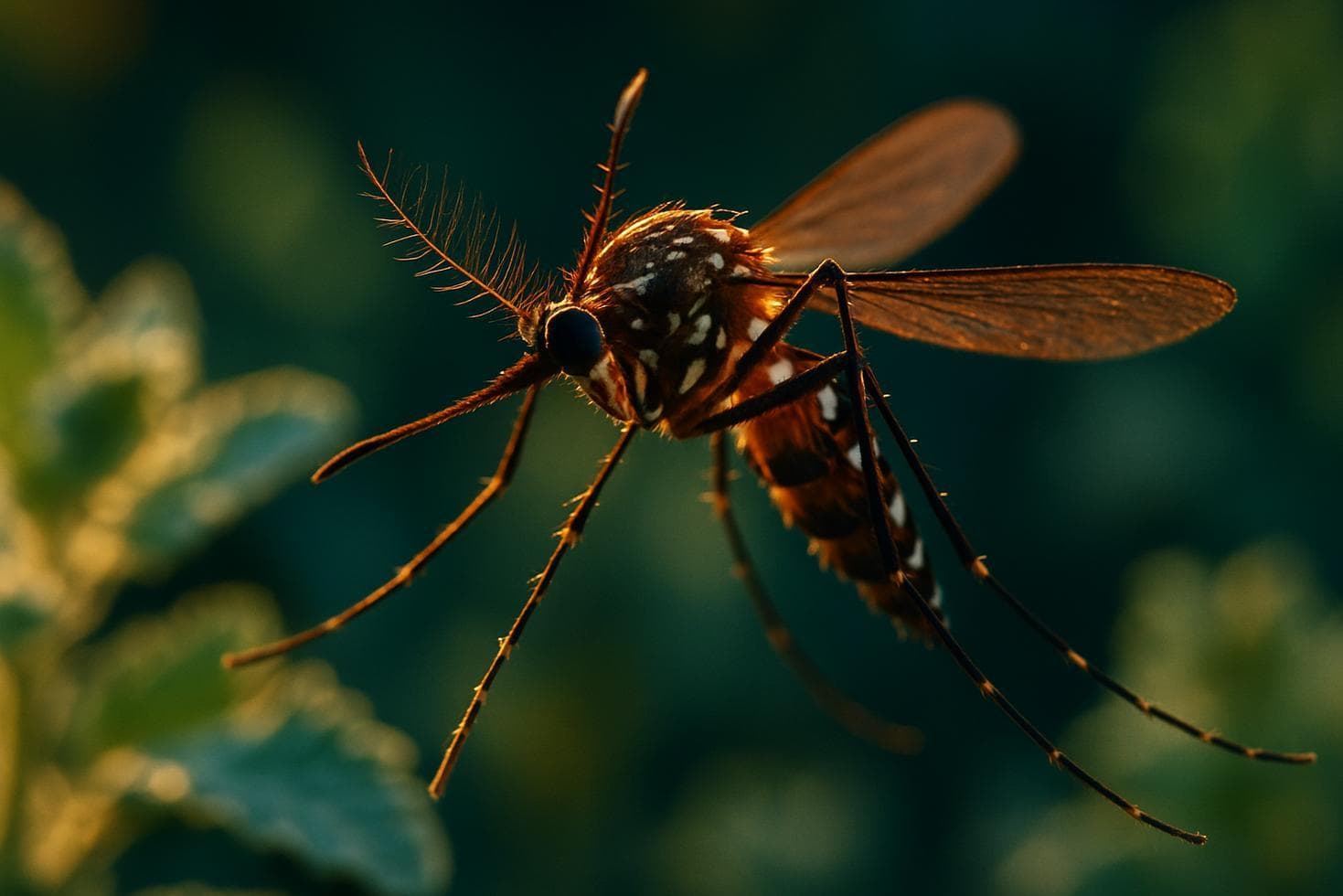
2% catnip oil repels more than 70% of mosquitoes for up to 4 hours — and a 6% lotion matches 15% DEET in field conditions. The cat toy is pulling real weight.
Catnip’s active compound, nepetalactone, repels mosquitoes by disrupting their olfactory host-seeking — not by killing them or blocking flight. The mosquito is still airborne and still hunting. It simply cannot find anything to hunt. That distinction matters more than it might seem, because it explains why catnip and DEET are strong in different situations.
Mosquitoes navigate by scent: carbon dioxide, skin chemistry, body heat. Nepetalactone masks those cues at the source, before a mosquito ever gets close enough to land. DEET operates differently, working as a contact repellent at the surface of treated skin or fabric.
How Nepetalactone Disrupts Mosquito Navigation
In USDA and University of Nebraska laboratory tests, catnip oil proved a stronger spatial repellent than DEET across three mosquito species: Aedes aegypti, Anopheles albimanus, and Anopheles quadrimaculatus. The researchers found catnip oil was more effective at masking chemical attractants and host odors, reducing mosquito attraction before any contact occurred.
DEET reversed that advantage the moment mosquitoes landed. In contact repellency tests, DEET repelled Ae. aegypti at roughly half the dose catnip oil required, and against An. albimanus the gap was even wider.
What Field Conditions and Recent Lab Work Actually Show
A field study in rural Eastern Uganda tested formulated lotions against real mosquito populations. The 6% catnip oil lotion and the commercial 15% DEET product produced equivalent repellence, reaching 79–89% depending on the measurement set. The 2% catnip lotion was only marginally behind.
A 2024 Scientific Reports study using a Y-tube olfactometer pushed the concentration down further. Catnip oil at 2% repelling 70%+ of mosquitoes for one to four hours confirmed that even dilute formulations perform meaningfully — and comparably to the 15% DEET benchmark in that olfactory test.
The earlier 2001 Iowa State/USDA lab assay produced results that circulated widely as “10 times stronger than DEET.” That framing came from a narrow tube bioassay measuring spatial avoidance at matched concentrations. It does not hold across all test types, and the fuller body of research shows context-dependent performance rather than a universal advantage.
Closing
Nepetalactone earns its reputation as a spatial repellent with real numbers behind it. What it does not do is replace DEET for contact protection — the two compounds operate on different stages of the same hunt.
A plant that simultaneously short-circuits a predator’s navigation and captivates cats is strange enough. The mechanism being purely behavioral, no paralysis, no knockdown, just a missing scent trail, makes it stranger still.
Frequently Asked Questions
Does catnip actually repel mosquitoes better than DEET?
In spatial repellency tests, catnip oil outperforms DEET; in contact repellency tests, DEET requires lower doses and lasts longer on treated surfaces.
How long does catnip oil repel mosquitoes?
A 2024 study found that 2% catnip oil repelled more than 70% of mosquitoes for between one and four hours.
What is nepetalactone and how does it work on mosquitoes?
Nepetalactone is an iridoid monoterpene in catnip essential oil; it disrupts mosquito host-seeking by masking the human odor cues mosquitoes use to locate targets.
Is crushed catnip as effective as catnip oil lotion?
The repellency research is based on formulated essential oil lotions at measured concentrations, not crushed leaves; efficacy is linked to nepetalactone concentration, not leaf preparation method.