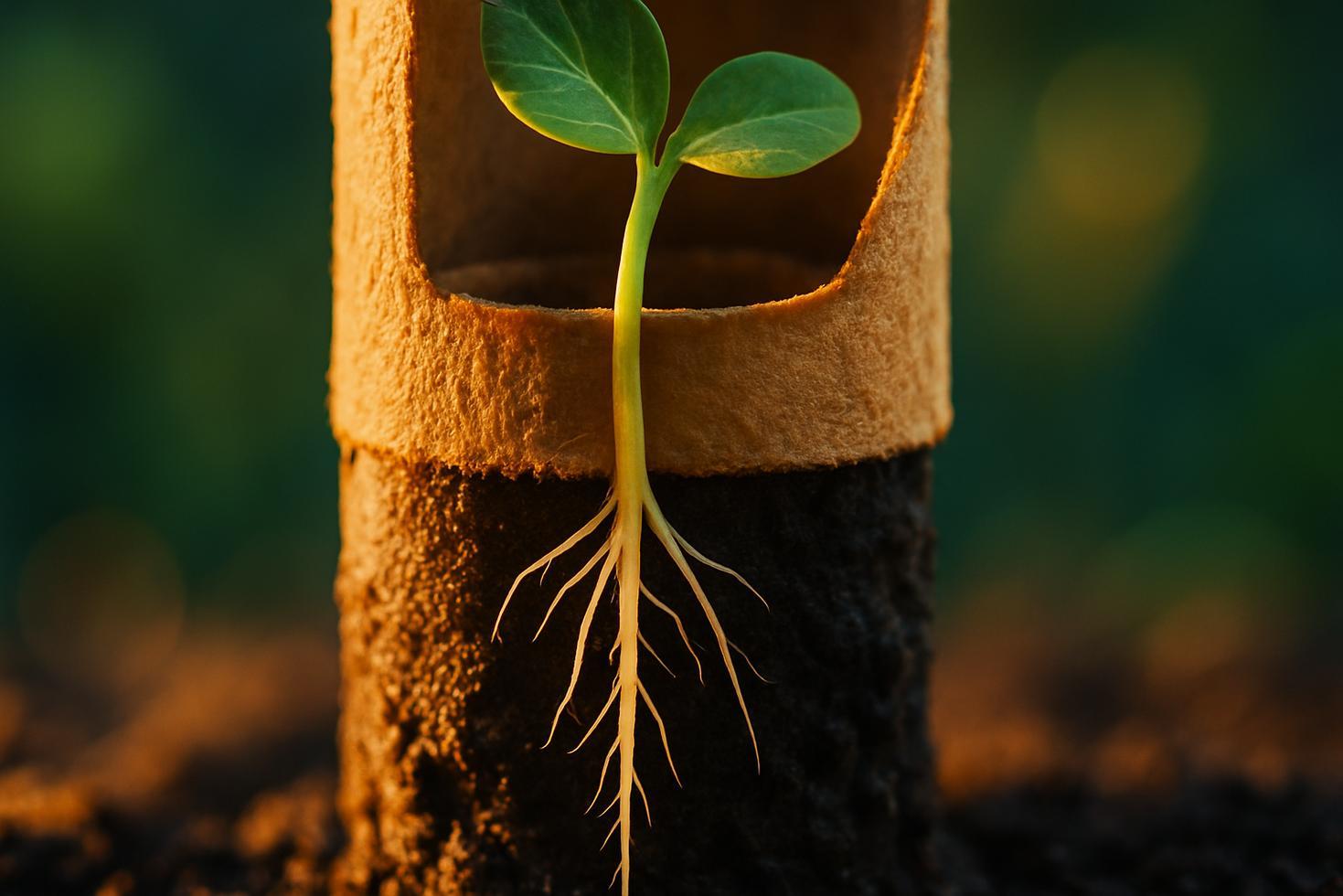
A toilet-paper tube 5–10 cm tall holds a seedling for 4–8 weeks — roots hit open air at the bottom, branch outward, and the whole tube goes into the ground.
A cardboard toilet-paper tube guides seedling roots straight down and air-prunes the tip when roots reach the open bottom, stimulating lateral branching before transplant. That sequence — confinement, then exposure, then branching — is the same logic behind commercial root trainers, achieved with something most households discard. Sweet peas are a natural fit here. Their taproots want distance and direction, and a tube gives them both.
The tube walls are plain cellulose, which is hydrophilic. Moisture moves through them easily. The open bottom is the key structural feature: roots exit downward rather than curling along the container floor.
How Air-Pruning Works at the Bottom of a Cardboard Tube
When a root tip exits the open bottom of the tube and contacts air, tip elongation stops. The plant then activates lateral roots behind that point. air exposure redirecting growth into lateral branches is the same mechanism nurseries use in mesh-sided root-trainer pots. The result is a denser, more branched system rather than one long strand with nowhere to go.
Roots in a solid-bottomed plastic pot have no such exit. They follow the container wall into a coil, which can persist after transplant and limit uptake. The tube removes that option entirely.
Why Sweet Peas and Taprooted Plants Suit This Method
Sweet peas are specifically noted as well-matched to cardboard tubes because they favor long, straight root runs. A shallow module tray cuts that run short. A tube 5–10 cm tall gives the taproot a direct downward channel and signals transplant readiness naturally — when roots appear at the base, it’s time.
taprooted species redirected by shallow containers lose that directional advantage before they’re ever in the ground. The tube preserves it through the seedling stage.
What Happens to the Cardboard After Planting
The tube is planted out intact. Cardboard is cellulose, and cellulose breaks down in moist soil, releasing organic matter back into the root zone. No roots are torn. No adjustment period follows. Sources recommend keeping filled tubes on a tray with drainage holes to prevent waterlogging before planting out.
No source in the available research gives a specific decomposition timeline for plain toilet-roll cardboard in garden soil, so that detail stays open.
The tube was always meant to disappear. The root system it shaped is the part that stays.
Frequently Asked Questions
Can any seedling be started in a cardboard toilet-paper tube?
The method works for any seedling, but it is especially suited to species with taproots or a preference for deep root runs, such as sweet peas.
Do the tubes need to be modified before use?
Sources describe filling them with peat-free multipurpose compost and standing them on a tray with drainage holes — no cutting or modification is required.
How do you know when the seedling is ready to transplant?
Roots appearing at the open bottom of the tube indicate the root system has developed sufficiently, typically within 4–8 weeks.
Does the cardboard harm the soil when it breaks down?
No source flags a harmful effect; sources describe decomposing cardboard as adding organic matter to the soil.