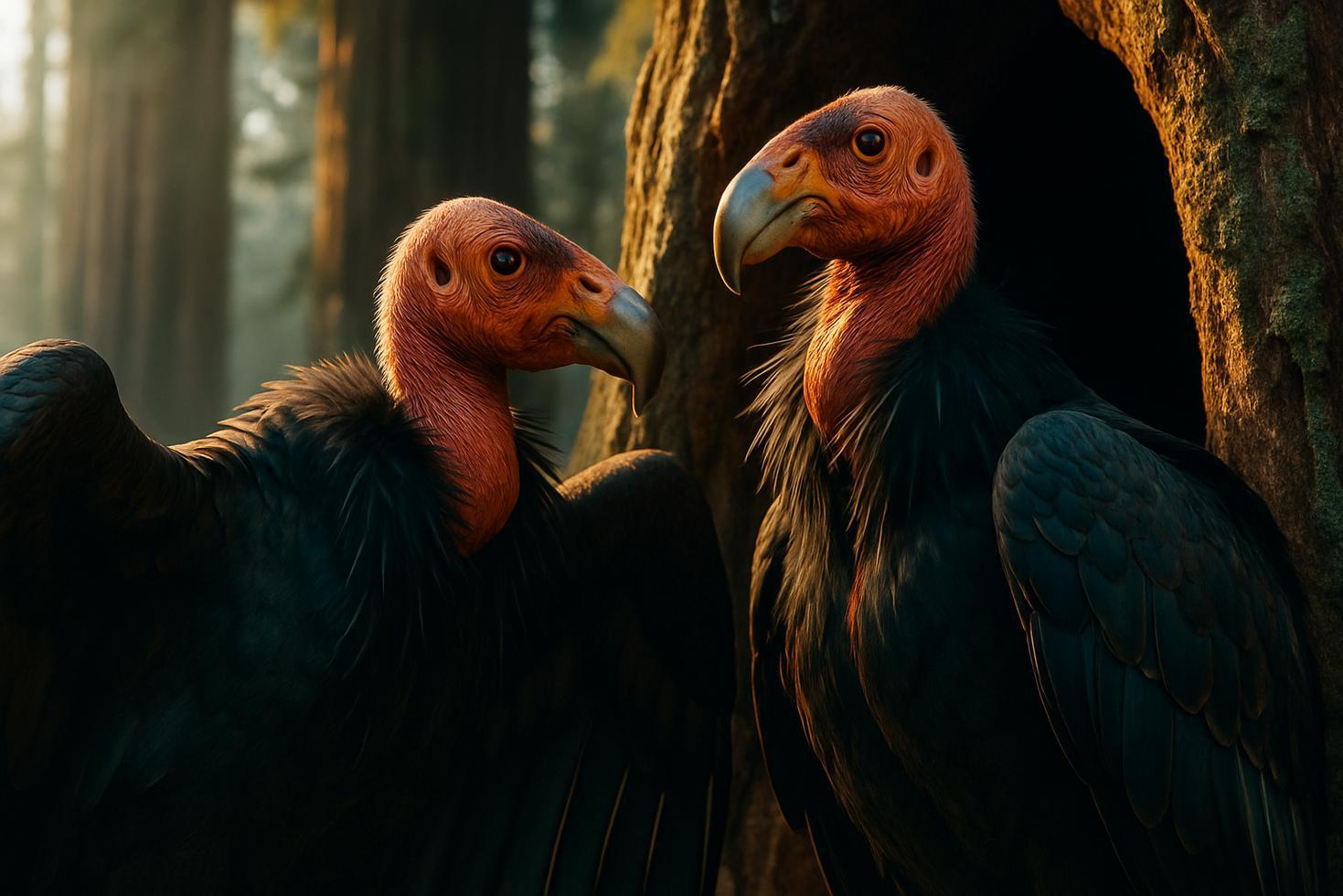
A group of four birds released in May 2022 grew to 24 free-flying condors over Yurok ancestral territory — and pair A1 and A0 built the first nest the redwoods had seen since 1892.
A California condor pair designated A1 and A0 established the first nest in northern California’s redwood region in more than a century, confirmed in 2024 by the Yurok Tribe’s Northern California Condor Restoration Program. That single nest closed an ecological gap that had been open since 1892. What makes it remarkable is not the symbolism — it’s the mechanism. No other bird currently operating in the redwood ecosystem strips a large carcass at the speed and scale a condor does.
The Yurok Tribe began working toward this moment in 2003, formally creating its Wildlife Program with condor reintroduction as its central focus in 2008. The first four birds touched down in Redwood National and State Parks in May 2022 — the northernmost release point in the species’ history.
Quick facts:
– Condors were absent from northern California since at least 1892 — more than 130 years.
– The Yurok Tribe formalized its condor restoration program in 2008, after work beginning in 2003.
– Four condors were released in May 2022; 24 now fly free within Yurok ancestral territory.
– Pair A1 and A0 built the first confirmed nest in the region in over a century, documented in 2024.
– The program plans at least one release cohort every summer for at least 20 years.
How California Condors Function as Apex Scavengers in a Redwood Forest
When a large animal dies in a redwood forest without a condor present, bacteria and insects handle the breakdown. That process is slow. A condor can strip the same carcass in hours, returning nutrients to the soil at a pace no hawk, raven, or eagle in the region matches.
Carcass removal at condor speed keeps decomposition from concentrating in one place, which matters for watershed health. Restoring that rate of nutrient cycling is the stated ecological goal of the Yurok-NPS-USFWS partnership, not just reestablishing a species count.
The Yurok Tribe’s Role in Building the Northern California Condor Restoration Program
This program is a formal partnership among the Yurok Tribe, National Park Service, and U.S. Fish and Wildlife Service. The Yurok frame condors not as a science experiment but as the return of a culturally significant relative to ancestral territory.
The program uses satellite and radio transmitters to monitor each bird. A management facility supports cohort formation before release and allows intervention when necessary. Monitored cohort formation before release gives each group of birds a social structure that improves survival odds in the wild.
Releases are planned every summer for at least 20 years. The math is patient because the ecology requires it — rebuilding a functional scavenger population in old-growth habitat is measured in decades, not seasons.
What 24 Condors Over Redwood Country Actually Signals
The four birds released in May 2022 became 24 free-flying condors across four rounds of releases. A confirmed nest followed. That sequence — release, survival, reproduction — is the benchmark the program was designed to reach.
The redwood ecosystem had been operating without its apex scavenger for over a century. The nest pair A1 and A0 built in 2024 is the first evidence the role is filling back in.
Frequently Asked Questions
When did condors disappear from northern California?
Condors have been absent from the northern California/Pacific Northwest range since at least 1892, according to U.S. Fish and Wildlife Service records.
Who runs the condor reintroduction in Redwood National and State Parks?
The Northern California Condor Restoration Program is a partnership among the Yurok Tribe, National Park Service, and U.S. Fish and Wildlife Service.
How many condors are now flying over Yurok ancestral territory?
As of the most recent Yurok Tribe figures, 24 condors fly free within Yurok ancestral territory, released across four cohorts since May 2022.
When was the first condor nest confirmed in the redwoods?
Pair A1 and A0 established the first confirmed nest in the region in more than a century, documented in 2024.