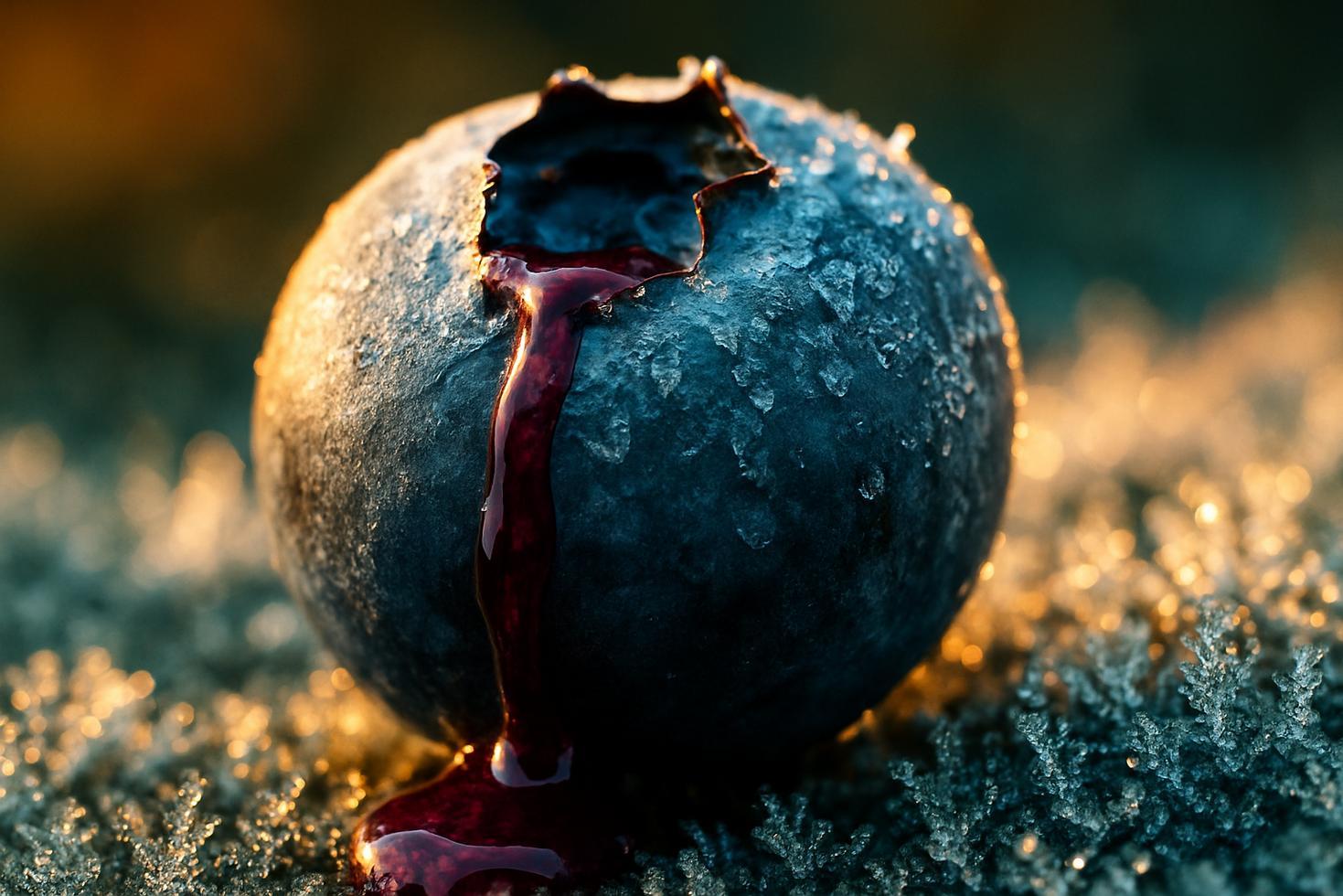
Drying blueberries destroys 41–49% of their anthocyanins. Freezing ruptures cell walls and changes how easily that pigment extracts — no new color created, just unlocked.
Freezing a blueberry does not create new anthocyanins — it changes how accessible the existing ones are. That distinction is worth understanding. A fresh blueberry holds its pigment inside intact cells. The color is real, but the cell walls hold it in place. When temperatures drop, ice crystals form inside the fruit, pushing outward and rupturing those walls from within. The pigment that was structurally trapped can then move freely.
What freezing does not do is universally increase total anthocyanin content. Studies show mixed results depending on cultivar, storage duration, and measurement method. The mechanism is physical disruption, not biosynthesis.
How Ice Crystal Formation Disrupts Blueberry Cell Structure
When a blueberry freezes, water inside its cells expands as it crystallizes. Those crystals physically puncture cell walls and membranes. This is a mechanical consequence of ice physics, not a targeted or selective process.
The result is that anthocyanin extractability changes with tissue disruption — pigment that was compartmentalized inside cells becomes measurable in ways it wasn’t before. One FAO-indexed study on highbush blueberries stored at -18°C and -35°C found no significant change in total anthocyanins during long-term frozen storage, while specifically noting the pigments became more easily extractable.
What the Numbers Actually Show About Fresh vs. Frozen Blueberries
One South Dakota State University study measured fresh blueberries at 3.32 ± 0.40 mg/g and frozen samples at 8.89 ± 3.56 mg/g after 133 days — but the same study showed lower values at 34 and 66 days and attributed the increase to leaching from tissue damage, not a consistent preservation effect.
A separate study found frozen samples at 8.1 ± 0.1 mg/g dry matter after one month and 7.9 ± 1.3 mg/g after three months — statistically comparable to fresh. Another study recorded fresh blueberries at 252.94 ± 20.860 mg/100 g and frozen samples lower at 211.78 ± 8.533 mg/100 g after month one, with the decrease most pronounced early in storage.
The range across studies reflects genuine variation by cultivar and measurement method, not a single clean answer.
Why Drying Compares Poorly to Freezing for Anthocyanin Retention
Drying does something structurally different from freezing. Heat and airflow destroy the pigment molecules themselves. Studies show drying causes 41–49% anthocyanin loss relative to frozen fruit. Freezing disrupts the cell walls without degrading the pigment. That difference in mechanism explains why frozen blueberries consistently outperform dried ones in this comparison.
The soft, thawed blueberry is not a lesser version of the fresh one. It is a structurally different one — with pigment that assays can reach more easily, preserved without the thermal destruction that drying brings.
Frequently Asked Questions
Does freezing increase anthocyanin content in blueberries?
Not reliably. Freezing can make anthocyanins easier to extract by rupturing cell walls, but total content varies by cultivar, duration, and method — some studies show no loss, others show decreases.
Are frozen blueberries better than dried for anthocyanin retention?
Yes, based on current evidence. Drying causes 41–49% anthocyanin loss compared to frozen fruit; freezing preserves pigment without thermal degradation.
Why do some lab measurements show higher anthocyanins in frozen blueberries?
Tissue disruption from ice crystals releases pigment into thawed exudate and makes it more accessible to extraction assays, which can raise measured concentrations even without new pigment forming.