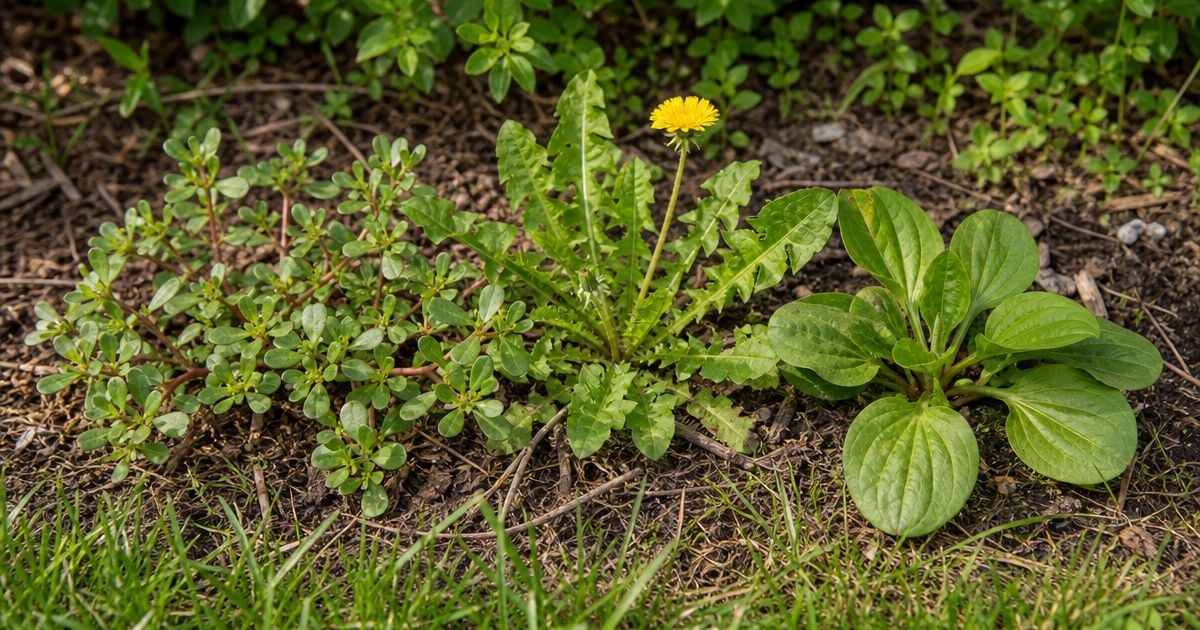
Some of the plants that pop up in your yard are good to eat. Five of the most common are dandelion, purslane, plantain, lamb’s quarters and stinging nettle.
This guide shows how to spot each one, what it offers and how to eat it safely. Think of them as nutritious wild foods, not medicine.
Before You Eat Any Wild Plant
Not every wild plant is safe, and some poisonous ones look like edible ones. Be sure of the plant and the place before you pick.
- Identify it. Use a regional plant guide or ask your local extension office. If you aren’t certain, don’t eat it. University of Missouri Extension puts it this way: if in doubt about a plant’s identity, pass it by.
- Know the edible part. Leaves, flowers, stems and roots are not always all safe. Eat only the parts named below.
- Skip treated and busy ground. Never pick from lawns sprayed with herbicides or pesticides. Avoid roadsides too, where plants can carry exhaust residue. Soil near older streets can also hold lead, and dandelions accumulate heavy metals from soil.
- Stay away from pet areas. Don’t harvest where pets or wild animals leave waste.
- Wash twice. Wash wild plants at least twice, changing the water each time.
- Start small. Try a small amount of any new plant first, in case you react to it.
- Ask first if it applies to you. People who have had kidney stones may need to limit oxalate. The National Institute of Diabetes and Digestive and Kidney Diseases lists spinach as one high-oxalate food. Purslane, lamb’s quarters and sheep sorrel also contain oxalate.
Five Common Edible Weeds
Nutrient figures below come from USDA FoodData Central. Percentages compare them with the FDA’s Daily Values.
1. Purslane
Purslane is a low, fleshy weed that likes full sun. The Missouri Department of Conservation says it grows in places like sidewalk cracks and tastes tart and lemony. Pick it from clean garden beds instead of pavement.
The leaves, stems and flower buds are edible, says the UC Master Gardener Program. Use them raw in salads or lightly sautéed.
Purslane has more than a pleasant taste. A 2014 review in The Scientific World Journal reports about 300 to 400 mg of alpha-linolenic acid (ALA) per 100 grams of fresh leaves. That is the plant omega-3, not the EPA and DHA in fish.
Watch for spurge. Spotted spurge looks a little like purslane but is not edible. UC IPM says broken spurge stems ooze a milky, poisonous sap that irritates skin and eyes. Snap a stem: purslane does not ooze, and its leaves are thick and fleshy.
Milky sap alone does not make a plant unsafe. Dandelion and chicory have it too. For purslane, it only helps you tell the two apart.
2. Dandelion
Leaves, buds, flowers and roots are all edible, says University of Wisconsin Extension. Young leaves picked before the flower buds open taste mildest. Heat and dry spells make leaves bitter.
One cup of raw, chopped greens (about 55 grams) has 103 mg of calcium. It has 428 mcg of vitamin K, roughly 3.6 times the Daily Value. It also has 279 mcg of vitamin A (RAE), 19.3 mg of vitamin C and 1.7 mg of iron.
Those are raw figures, and cooked greens differ. The NIH Office of Dietary Supplements says people taking warfarin need to keep vitamin K intake consistent.
Add young leaves to salads and soups. For older leaves, boil until tender and change the water once to mellow the taste, as University of Maine Extension suggests. Or sauté them with garlic and olive oil.
Flowers taste sweetest early in the season and close up fast, so use them right away. Roasted roots make a coffee-like drink with no caffeine, notes Cleveland Clinic.
Want the full numbers and what the studies show? See our guide to dandelion benefits.
3. Plantain
This is the lawn weed, not the banana-like fruit. It grows as broadleaf and narrowleaf types, and both are native to Europe and Asia. University of Minnesota Extension says they are believed to have reached North America in the 17th century.
The old nickname “Englishman’s foot” reflects how plantain followed European colonists, notes a 2022 study in Frontiers in Plant Science.
NC State Extension says young, tender leaves can be eaten raw, while older, tougher leaves are better boiled in stews. It calls plantain high in calcium and vitamins A, C and K.
Pick small leaves, since larger ones turn tough. Large amounts can lower blood pressure. Plantain is also high in vitamin K, so check with your doctor first if you take a blood thinner.
4. Lamb’s Quarters
Lamb’s quarters, also called goosefoot, makes a good cooked stand-in for spinach. Young leaves wear a fine white to gray mealy coating, heaviest on new growth and the undersides. University of Nevada, Reno Extension describes the top as whitish and powdery.
Pick young, tender leaves from the top of the plant. Check the coating, because Cornell notes that redroot pigweed seedlings lack it. Halberdleaf orach looks similar too, so be sure of the plant before you eat it.
The plant contains saponins and oxalic acid, so cook the leaves by boiling, steaming or sautéing. Eat normal servings, not large amounts.
One cup of cooked, drained leaves (about 180 grams) has roughly 7 times the Daily Value of vitamin K. It also has about 78% of the Daily Value for vitamin A, 74% for vitamin C and 36% for calcium.
That much vitamin K matters if you take warfarin, so keep your intake steady.
5. Stinging Nettle
Raw nettles sting, so protect yourself. Oregon State University Extension advises long sleeves, long pants and long rubber kitchen gloves.
Pick young shoots in early spring, before the plant flowers. Once flowers appear, the greens get tough. Boil the leaves for 1½ to 2 minutes, then cool them in ice water. The heat destroys the stinging hairs. Oregon State also says to dry or blanch nettles before use.
Cook them as you would spinach. One cup of blanched nettles (about 89 grams) has roughly 428 mg of calcium, 33% of the Daily Value. It also has magnesium, potassium and iron, though many other foods do too.
Nettle is sold as a remedy, but the research is limited. The National Center for Complementary and Integrative Health reports only limited evidence, for urinary symptoms from an enlarged prostate.
Memorial Sloan Kettering Cancer Center says nettle may interact with diuretics, blood pressure drugs and diabetes medicines. Ask your doctor first if you take any.
More Wild Edibles to Explore
These need the same care: sure identification, clean ground and a good wash.
- Chicory: Young leaves can be eaten raw, though they are bitter, or cooked to mellow the taste. Roasted, ground roots make a caffeine-free coffee substitute. Chicory is a relative of dandelion, and both are composite flowers.
- Sheep sorrel: The small, arrow-shaped leaves taste tart and lemony. Use small amounts, raw or cooked. The oxalic acid can harm the kidneys if you eat a lot.
- Violets: The flowers and leaves of common blue violet are edible, but the roots are not. University of Illinois Extension warns that African violets are unrelated and not safe to eat.
- Garlic mustard: All parts are edible. Use the leaves in salads or pesto and the roots in soups. It is invasive in many states, so bag pulled plants instead of composting them, and follow your state’s rules.
- Chickweed: The tender leaves, stems and flowers of common chickweed are edible raw or cooked. Pick only from untreated lawns.
- Wild garlic: The bulbs, leaves, flowers and stems are edible. Harvest only plants with a strong onion smell. Death camas is a toxic look-alike that lacks the onion odor. If someone eats a plant by mistake, call Poison Control at 1-800-222-1222, as University of Utah Poison Control advises.
- Burdock: The roots are the main edible part. Young leaves and flower stalks are also edible before the flowers appear.
Make Room for a Few Edible Weeds
Plants that volunteer in your yard have already adapted to your soil and light, so they need little care. You can enjoy them without a jungle by trimming them to keep things tidy.
No yard space? Grow greens in a pot sized for greens and herbs instead.
Frequently Asked Questions
Which weeds in my yard are edible?
Dandelion, purslane, plantain, lamb’s quarters and stinging nettle are five common edible weeds. Eat a wild plant only when you are certain what it is, pick from ground never sprayed, and wash it at least twice.
How do I tell purslane from spurge?
Snap a stem. Spurge oozes milky, poisonous sap, and purslane does not. Purslane’s leaves are also thick and fleshy. If you are still not sure which plant you have, don’t eat it.
Is it safe to eat weeds from my lawn?
Only if the lawn was never treated with herbicides or pesticides. Skip roadsides and places where pets leave waste. Wash wild greens at least twice in fresh water, and try a small amount first.
Can you eat stinging nettle?
Yes, after you cook it. Wear long rubber gloves, pick young spring shoots, and boil them for 1½ to 2 minutes. Cooking destroys the stinging hairs. Raw nettle stings, and tough older leaves are poor eating.
Who should be careful with edible weeds?
People who take warfarin should keep vitamin K intake steady. People who have had kidney stones may need to limit oxalate. If you take medicines or have a health condition, ask your doctor before adding wild greens to your diet.