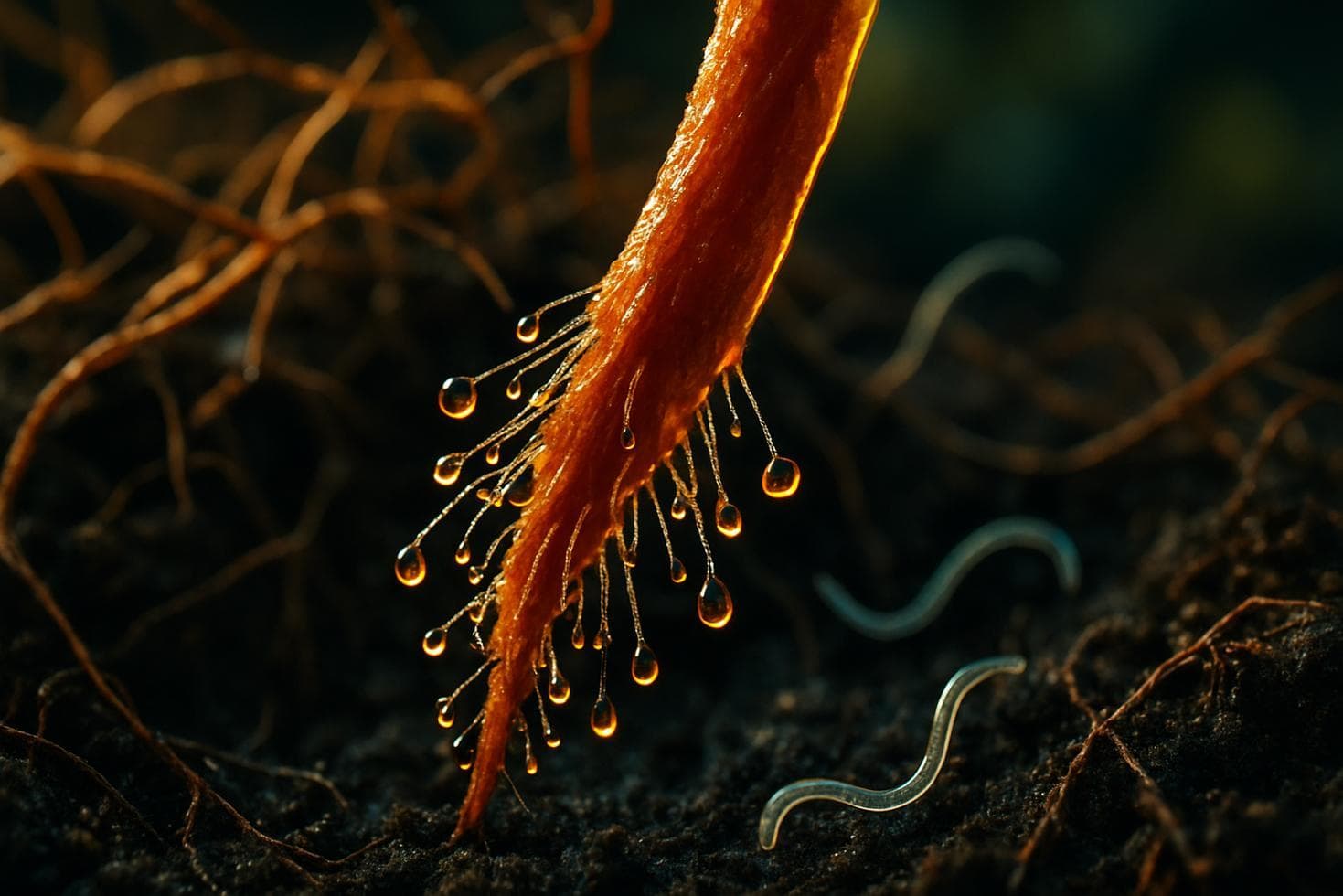
Marigold roots leak alpha-terthienyl into soil — at just 2 ppm, it triggers oxidative damage that shreds nematode cell membranes from within. The flower isn’t decorating. It’s dismantling.
Marigold roots (Tagetes spp.) produce and exude a polythiophene compound called alpha-terthienyl that kills plant-parasitic nematodes by generating reactive oxygen species that destroy cell membranes from within. That mechanism alone would be remarkable. The concentration required makes it stranger still.
At just 2 parts per million — 2 milligrams per liter of water — alpha-terthienyl causes 100% inhibition of root-knot nematode (Meloidogyne incognita) egg hatching and 100% mortality of second-stage juveniles under laboratory conditions. The compound doesn’t slow them down. It stops an entire generation before it begins.
How Alpha-Terthienyl Generates Oxidative Damage Inside Nematodes
The classical mechanism is photoactivated. When UV-A light (approximately 320–400 nm) strikes alpha-terthienyl, the molecule absorbs a photon and enters a triplet excited state. In that state, it transfers energy to ground-state oxygen, generating singlet oxygen — a highly reactive oxygen species. That singlet oxygen attacks unsaturated fatty acids in nematode cell membranes, a process called lipid peroxidation of membrane phospholipids, causing structural collapse, loss of ionic balance, paralysis, and cell death.
This is categorically different from neurotoxicity. No nerve receptor is targeted. The membrane itself is the target.
More recent research on C. elegans and M. incognita shows alpha-terthienyl also kills nematodes in complete darkness. In those experiments, the compound penetrates the nematode cuticle and triggers internal oxidative stress, detectable through upregulation of enzymes like glutathione S-transferase and superoxide dismutase. The compound appears to be an oxidative stressor by more than one pathway.
Alpha-Terthienyl Potency Across Multiple Nematode Species
The 2 ppm figure for M. incognita sits at the higher end of alpha-terthienyl’s concentration range. Against the potato cyst nematode Globodera rostochiensis, effective lethal concentrations drop to 0.1–0.2 µg/mL. Against Anguina tritici, the threshold is around 0.5 µg/mL. Against Ditylenchus dipsaci, approximately 5 µg/mL suffices.
At much higher concentrations — 20 and 40 µg/mL — it disrupts host-finding behavior and induces mortality in the entomopathogenic nematode Steinernema glaseri, a species not even parasitic to plants.
The compound’s activity in soil is strongest near the surface, where UV-A light can still penetrate. Because alpha-terthienyl is lipophilic, it partitions readily into nematode tissue in that shallow zone.
Closing
The marigold isn’t deploying this chemistry with any aim. Alpha-terthienyl is simply produced in the roots and exuded into the rhizosphere as a byproduct of the plant’s normal biochemistry. The nematicidal consequences are, in that sense, incidental to the plant’s existence.
What’s not incidental is the potency. At concentrations measured in single-digit parts per million, a common garden flower accomplishes something synthetic pesticide programs have spent decades trying to replicate.
Frequently Asked Questions
What is alpha-terthienyl and where does it come from?
Alpha-terthienyl is a polythiophene compound produced in the roots of Tagetes species, including T. erecta and T. patula, and exuded into surrounding soil.
Does alpha-terthienyl attack nematode nervous systems?
No. Peer-reviewed research identifies oxidative membrane damage via singlet oxygen and lipid peroxidation as the primary mechanism, not neurotoxicity.
Does alpha-terthienyl need sunlight to work?
Photoactivation by UV-A light (320–400 nm) produces singlet oxygen and is the classical mechanism, but recent studies confirm nematicidal activity in dark conditions through internal oxidative stress.
How effective is alpha-terthienyl against root-knot nematodes specifically?
At 2 ppm, laboratory assays show 100% inhibition of Meloidogyne incognita egg hatching and 100% mortality of second-stage juveniles.