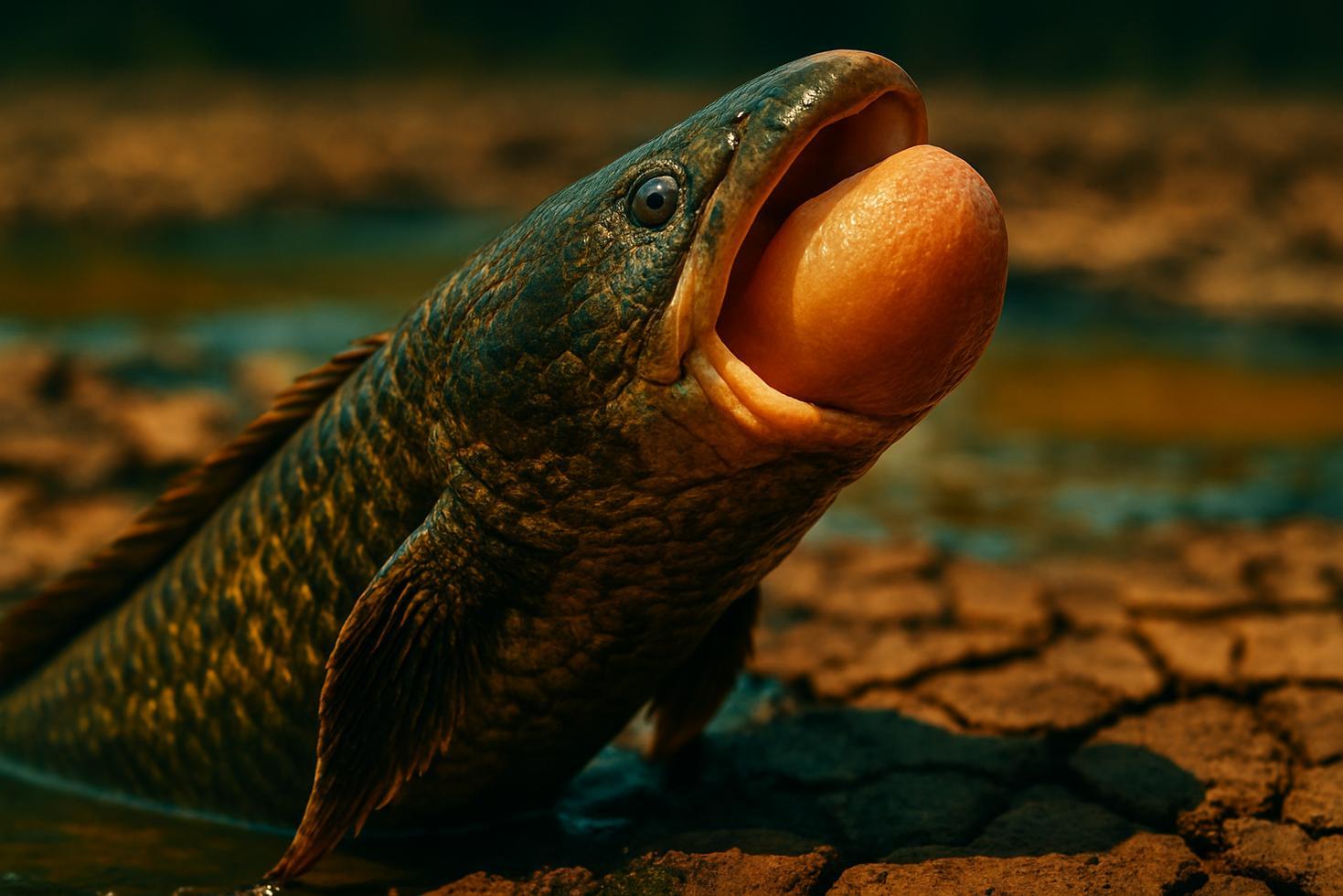
Lungfish pull 90% of their oxygen from air, not water. Seal one below the surface, and it suffocates like any land animal.
The African lungfish is an obligate air-breather — it will drown if held underwater without access to the surface. That single fact reframes everything about how fish are supposed to work. The lungfish belongs to the lobe-finned lineage Sarcopterygii, the same broad group that gave rise to the first land-walking vertebrates, and its lungs are not a curiosity. They are the primary engine keeping it alive.
Its gills are reduced in adults to the point of near-uselessness. The real work happens through a paired lung connected directly to the pharynx — a modified outpocketing of the gut, no trachea involved.
How African Lungfish Breathe: Lungs, Not Gills
African and South American lungfish have paired lungs. The Australian species has only one. In African lungfish, the gills of adults are so reduced they contribute almost nothing to gas exchange. Lungs connected to the pharynx, not a trachea handle the job instead. This is why the fish must surface regularly, and why submerging it completely is fatal.
What Happens When the Pond Dries Up: Estivation in Mud
When drought swallows a pond, the African lungfish digs into the mud. It secretes a cocoon of mucus that hardens around its body, leaving a small airhole at the surface. Metabolism drops dramatically. The fish takes no food and produces no waste of consequence. It simply waits. Verified records show this can continue for up to four years. When rain softens the earth again, the fish rehydrates and resumes normal behavior.
What Lungfish Reveal About the Water-to-Land Transition
Lungfish fossils appear in Early Devonian rock, dated to roughly 419 to 393 million years ago. Six species survive today — four in Africa, one in South America, one in Australia. Researchers studying how vertebrates first moved onto land return to lungfish repeatedly, not as metaphor but as evidence. Their fleshy paired fins contain a well-developed internal skeleton, the structural precursor to limbed locomotion. They are still fish. But the biology that made land life possible is already present, operating, and 400 million years old.
Closing
A fish that drowns in water is a genuinely strange thing to encounter. The African lungfish makes that strangeness routine — surfacing, burrowing, waiting out years of drought in a shell of its own making. It did not evolve toward land and stop halfway. It found a way to stay aquatic while carrying the equipment of a land animal. That turns out to be a remarkably durable strategy.
The oldest vertebrate blueprint for breathing air is still breathing.
Frequently Asked Questions
Can an African lungfish really drown?
Yes. African lungfish are obligate air-breathers that get roughly 90% of their oxygen from the surface. Blocking surface access causes suffocation.
How long can a lungfish survive in mud without water?
African lungfish can estivate in a hardened mucus cocoon in mud for up to four years, verified by sources including the San Diego Zoo Wildlife Alliance.
Are lungfish related to the first land animals?
Lungfish belong to Sarcopterygii, the lobe-finned lineage that also produced the ancestors of tetrapods. They are the closest living fish relatives to that ancestral group.
How many species of lungfish exist today?
Six species survive: four in Africa, one in South America, and one in Australia.