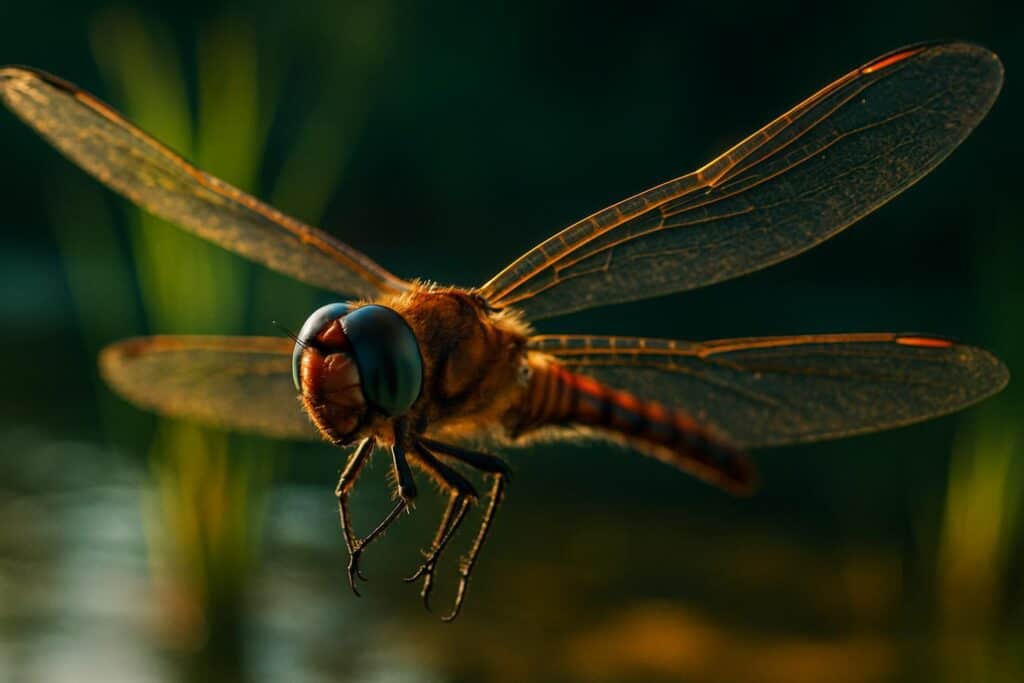
16 neurons tile a full 360° of sky — steering 75% on a computed path, not reaction — in under 500 milliseconds.
Dragonflies do not follow their prey — they calculate where the prey will be and fly directly to that future point. That distinction sounds subtle, but it changes everything about how a hunt unfolds. The dragonfly launches toward a location that doesn’t exist yet, and the prey arrives there to meet it.
The entire sequence — detection, prediction, steering, and capture — wraps up in 200 to 500 milliseconds. That is not enough time for the prey to respond.
The 16 Neurons That Encode the Interception Vector
Eight pairs of giant descending neurons — 16 total — sit at the core of this system. These target-selective descending neurons (TSDNs) respond exclusively to small moving objects crossing the dorsal visual field. Together, their population code covers a full 360° of azimuth and sends a precise prey-direction vector down to the thoracic wing motors.
When the prey image drifts off the eye’s acute zone, these neurons detect the drift and trigger compensatory wing signals that restore fixation. Population coding across all 16 cells gives the brain a continuously updated interception geometry, not just a snapshot of where prey is now.
How Dragonfly Predictive Steering Actually Works
The 75% figure is what makes this system remarkable. In kinematic studies using high-speed motion capture, roughly three-quarters of all steering inputs during a hunt were not tied to deviations in the prey’s path. The dragonfly was running ahead of its own data, executing a course it had already internally computed.
This is forward modeling — predicting the visual consequences of both the prey’s motion and the dragonfly’s own body rotation before either has fully played out. Stacey Combes’s Nature commentary identified this as the first forward model confirmed in an invertebrate, comparable in principle to how a human brain estimates where a thrown ball will land.
The head and body operate as two separate stabilization systems simultaneously. The head rotates predictively to cancel image drift before it happens. The body independently maneuvers to hold the interception trajectory.
What STMD Neurons Reveal About Neural Prediction
Small target motion detector (STMD) neurons add a second layer. Laboratory experiments with simulated moving targets showed that STMD activity peaks not at the prey’s current retinal position but at a point slightly ahead of it — where the prey is going, not where it is.
When the target disappears behind an object, this activity focus continues shifting forward along the extrapolated motion path, predicting where the target will reappear based on its prior trajectory. The mechanism is strictly mathematical: past motion data, extrapolated forward.
Dragonflies come in from below, aligning their body axis with the prey’s flight direction and closing the vertical gap. Prey primarily watch above for threats. The dragonfly arrives from beneath, already aligned.
A nervous system occupying a fraction of a cubic millimeter runs a live intercept calculation fast enough that the prey is still reacting while the outcome is already resolved.
Frequently Asked Questions
How many neurons do dragonflies use to track prey direction?
Dragonflies use 16 target-selective descending neurons arranged in eight pairs, collectively covering 360° of azimuth in the dorsal visual field.
What does “75% of steering uncoupled from prey movement” mean?
In motion capture studies, roughly three-quarters of steering inputs during a hunt followed the dragonfly’s internally computed path rather than responding to what the prey just did.
Are dragonfly forward models similar to human motion prediction?
Mechanistically yes — both use internal predictions of future object position rather than pure reaction — but no quantitative comparison of reaction times or neuron counts between the two has been verified.
How fast is a dragonfly hunting sequence?
From launch to capture, a typical hunt lasts 200 to 500 milliseconds.