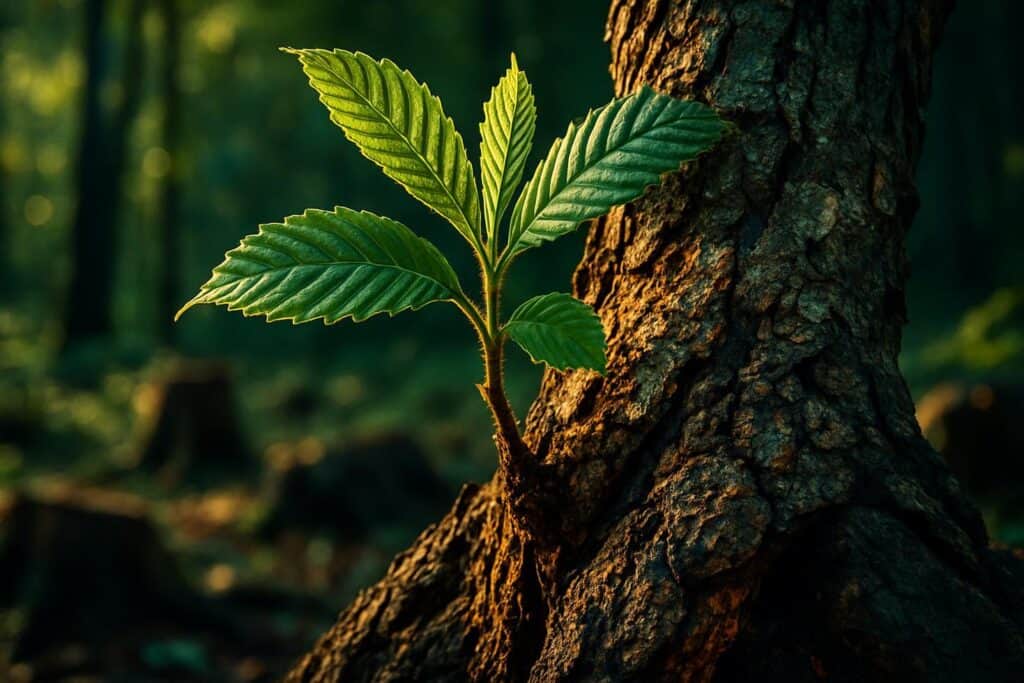
Three to four billion American chestnuts fell to a single fungal acid — and one wheat enzyme, inserted into the chestnut genome, breaks that acid apart before it can kill.
The fungus Cryphonectria parasitica wiped out an estimated 3 to 4 billion American chestnut trees across eastern U.S. forests between roughly 1900 and 1940. That figure comes from forest inventory reconstructions and is widely cited in scientific literature, though exact counts were never directly measured. What makes the loss stranger is that the chestnut never fully disappeared — its roots kept living, kept sending up shoots, and kept getting killed again.
The mechanism is specific. Cryphonectria parasitica floods infected bark tissue with oxalic acid, dropping the local pH until cambial cells — the living layer that moves nutrients under the bark — stop functioning entirely. The tree girdles and dies above ground. Below ground, the root system survives. New sprouts emerge, rarely reach canopy size before reinfection, and the cycle repeats.
How Oxalic Acid Destroys Chestnut Bark — and How the Wheat Enzyme Stops It
The oxalate oxidase (OxO) enzyme, native to wheat, catalyzes a direct conversion: oxalate broken into CO₂ and hydrogen peroxide. In Darling 58, that same enzyme is expressed in chestnut bark tissue. When Cryphonectria parasitica infects the tree and begins producing oxalic acid, the OxO enzyme degrades it before concentrations rise high enough to kill cambial cells. Darling 58 is not immune to blight. It shows reduced canker size and improved survival compared with wild-type American chestnut — partial resistance, not complete protection.
The OxO gene came from wheat because wheat already deploys it against oxalate-producing pathogens in agricultural settings. One mechanism, borrowed across a large evolutionary distance, repurposed for forest restoration.
What USDA APHIS Has and Has Not Approved for Darling 58
SUNY College of Environmental Science and Forestry (ESF) submitted a petition to USDA APHIS in November 2019, requesting a determination of nonregulated status for Darling 58 under 7 CFR part 340. That determination would remove the need for APHIS permits for planting. As of October 2021 — the date of APHIS’s draft environmental impact statement — no American chestnut variety had been granted nonregulated status. Darling 58 plantings remained confined field trials under permit.
APHIS’s draft EIS does analyze scenarios in which Darling 58 is granted nonregulated status and planted across large portions of its historical range. Those scenarios include evaluation of gene flow to remnant wild chestnut sprouts, potential shifts in forest composition, and effects on wildlife that depended on chestnut mast before the blight. None of that has been authorized yet. The permit stage constrains planting size, location, and seed distribution.
The roots of American chestnut have been cycling through that blight loop for over 120 years. Whether Darling 58 gets the regulatory clearance to leave confined trials is still an open question. But the biochemical answer to oxalic acid — a wheat enzyme converting acid into gas — has been sitting in the genome of a grass for a very long time.
Frequently Asked Questions
What caused the American chestnut blight?
The fungus Cryphonectria parasitica, native to Asia, was introduced to North America in the late 19th or early 20th century, likely via imported Asian chestnut trees.
How does Darling 58 resist chestnut blight?
It expresses a wheat-derived oxalate oxidase enzyme that breaks down the oxalic acid Cryphonectria parasitica produces, reducing canker formation and improving survival — though the tree is not fully immune.
Has USDA approved Darling 58 for unrestricted planting?
As of October 2021, no. ESF petitioned APHIS for nonregulated status in November 2019; a final determination had not been issued, and all plantings remained under permit.
Do American chestnut trees still exist in the wild?
Yes — as root sprouts. Wild chestnuts persist underground and send up stems that rarely reach canopy size before blight reinfects and kills them back.
Source: USDA APHIS, Draft Environmental Impact Statement for Darling 58 American Chestnut Nonregulated Status Petition (ESF, November 2019).