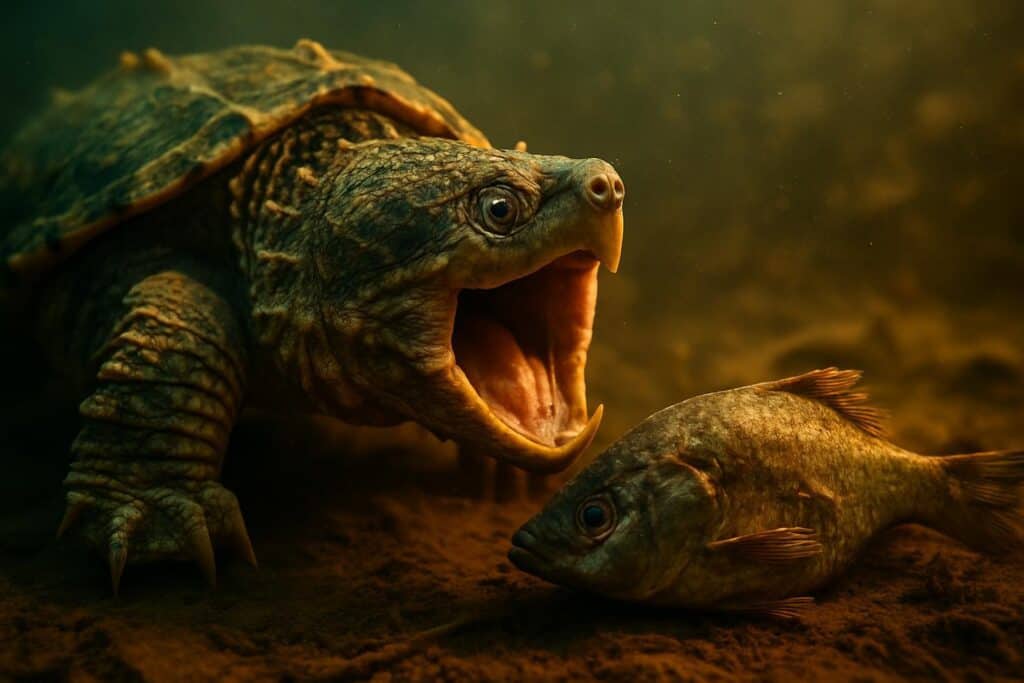
A snapping turtle documented at 40+ years old has been pulling carrion off the same pond bottom since before the fence went up — removing the organic fuel that bacteria would otherwise burn through oxygen to decompose.
Common snapping turtles (Chelydra serpentina) are documented scavengers that consume dead fish and other carrion, removing organic matter that would otherwise decompose in place and drive down dissolved oxygen levels. That is not a minor housekeeping detail. It is a direct link between one animal’s feeding behavior and the chemical conditions everything else in the pond depends on.
The Ontario Ministry of Natural Resources and Forestry confirms common snapping turtles can live more than 30 years in the wild, with documented individuals reaching 40 or more years. A turtle that old has been working the same water longer than most residential properties have had their current owners.
How Snapping Turtle Scavenging Connects to Dissolved Oxygen
When a fish dies and sinks, bacteria go to work. That microbial decomposition consumes dissolved oxygen and releases nitrogen and phosphorus into the water column. In warm, slow-moving, or stratified ponds, that process can push oxygen low enough to trigger fish kills and algal blooms fed by the released nutrients.
A snapping turtle consuming that carcass intercepts the decomposition pathway entirely. The organic material moves through the turtle rather than through a bacterial bloom. Nutrients are still cycled — turtles excrete waste — but the timing and location change, and the acute oxygen drawdown from in-place decomposition is reduced.
This mechanism is consistent with documented freshwater ecology. It is worth being precise about what the research does and does not show: there are no published studies that have isolated and measured the net change in pond oxygen levels attributable specifically to snapping turtle scavenging. The mechanism is sound; the magnitude, pond by pond, has not been directly quantified.
What Snapping Turtles Are Not
The scavenging role is real, but it shares the pond with crayfish, certain fish species, insect larvae, and microbial decomposers. Snapping turtles are one member of the scavenger guild, not the sole operator.
A pond’s oxygen budget and nutrient load are shaped by fertilizer runoff, stormwater, sediment, macrophyte communities, temperature, and hydrology — factors that dwarf the influence of a single large reptile. Turtle removal shifts the scavenger community, not the entire pond’s fate. The ecosystem literature does not support characterizing any single snapping turtle as the primary line of defense against system collapse.
What mainstream wildlife guidance does consistently support: these turtles are native, long-term residents that play a natural role, and unnecessary removal is not recommended.
Frequently Asked Questions
How long can a snapping turtle live in the same pond?
The Ontario Ministry of Natural Resources and Forestry documents wild lifespans exceeding 30 years, with some individuals confirmed at 40 or more years. Individuals show strong site fidelity.
Do snapping turtles actually eat dead fish?
Yes. Pennsylvania, Massachusetts, and other state wildlife agencies explicitly list carrion, including dead fish, as part of the snapping turtle’s documented diet.
Can removing a snapping turtle harm a pond’s water quality?
Removing one turtle reduces the scavenger guild’s capacity, which can allow more organic matter to decompose in place — increasing oxygen demand. However, snapping turtles are one of several scavengers in most systems, not the only one.
Are snapping turtles dangerous to a pond’s fish population?
State extension publications note they are not typically responsible for fishery declines in natural or well-managed ponds, though in small, intensively stocked aquaculture settings, management decisions may differ.