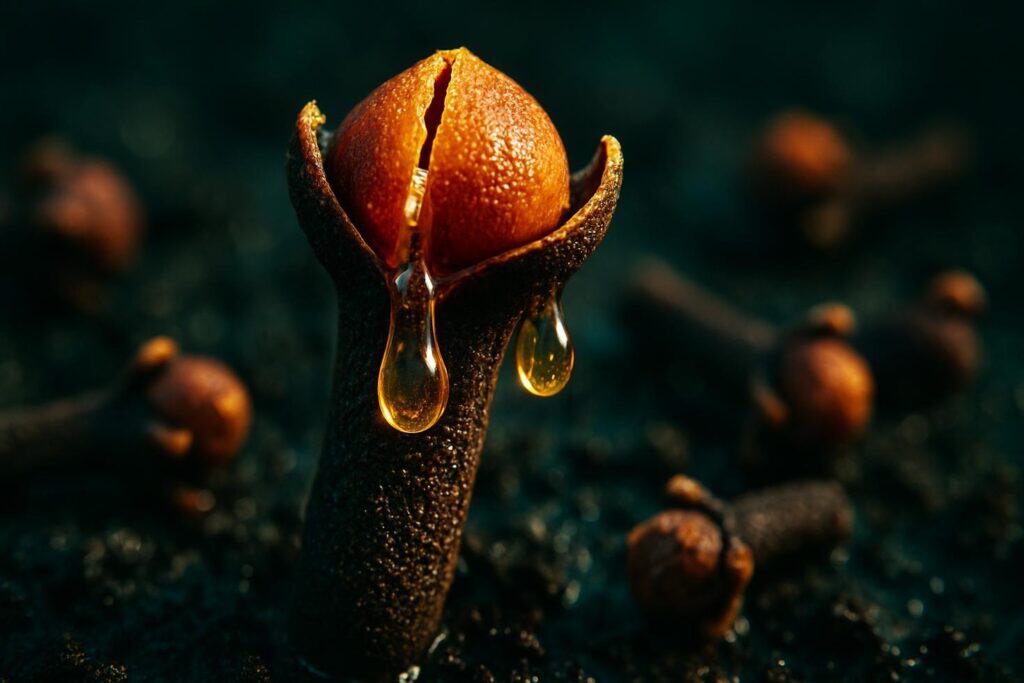
Cloves naturally contain eugenol — and at just 5% concentration, its acetylated derivative stopped Candida albicans from growing in verified lab testing. The chemistry was already inside the plant.
The clove bud synthesizes eugenol inside living tissue as a defense compound, storing it in microscopic oil pockets distributed throughout the flower bud. That single phenolic molecule carries measurable antifungal activity. Lab testing confirmed that acetyleugenol — a derivative of eugenol — inhibited Candida albicans at concentrations of 5% and 10%.
What makes eugenol structurally interesting is where it sits chemically. It dissolves in water at 2,460 mg/L at 25 °C — moderately soluble, not fully. That middle position between oil-soluble and water-soluble matters because fungal cell membranes are lipid-based environments, exactly the kind of structure eugenol can penetrate.
How Eugenol Disrupts Fungal Cell Membranes
Eugenol is a phenolic compound, meaning it carries a hydroxyl group attached to an aromatic ring. That phenolic hydroxyl group interacts with lipid membranes, disrupting their structure and compromising the cell’s ability to maintain integrity. The result is membrane damage that the fungal cell cannot repair under sufficient eugenol exposure.
This mechanism is why antifungal testing against Candida albicans focuses on concentration thresholds. At 5% and 10%, acetyleugenol — eugenol’s esterified form — showed measurable inhibitory activity in published research.
What Acetyleugenol Actually Is — and How It’s Made
Acetyleugenol is not something a clove produces on its own. It is a laboratory derivative, made by acetylating eugenol’s phenolic hydroxyl group using acetic anhydride as a reagent — not vinegar.
The distinction matters. Vinegar is dilute acetic acid in water. Acetic anhydride is a different, more reactive compound. Published syntheses require controlled heat, catalysts, and specific reagents to drive the reaction. One optimized method used a 1:5 molar ratio of eugenol to acetic anhydride, a 2% solid acid catalyst, 500 rpm stirring, 80 °C temperature, and 40 minutes of reaction time to reach 99% conversion. A sonochemical method reported yields of only 3.49–3.50% under ultrasonic conditions at 70–80 °C. This is chemistry that requires a lab, not a jar left on a counter.
Why Cloves Preserved Food Before Anyone Understood the Mechanism
Ancient spice traders moved cloves across continents partly because food stored near them resisted spoilage longer. The molecular reason was unknown to them. The eugenol was already doing the work — disrupting microbial membranes, sitting in that useful chemical middle ground between fat and water.
Eugenol’s partial water solubility enabled contact with the watery surface environments where microbes operate, while its lipophilic character let it interact with cell membranes. The plant did not optimize for this outcome. It produced the compound for its own defense, and the antifungal consequence followed from the chemistry.
The clove bud is a small object with a well-documented molecular toolkit. The antifungal activity is real, the mechanism is membrane disruption, and the chemistry is specific. That is already a strange enough story without exaggeration.
Frequently Asked Questions
What is eugenol and where does it come from?
Eugenol is a phenolic compound produced naturally in clove buds, stored in oil pockets distributed throughout the flower.
Does eugenol kill Candida albicans?
Acetyleugenol, a lab-derived derivative of eugenol, showed antifungal activity against Candida albicans at 5% and 10% concentrations in published testing.
Can vinegar turn eugenol into acetyleugenol at home?
No. Acetyleugenol synthesis requires acetic anhydride — not vinegar — along with a catalyst, heat around 80 °C, and controlled conditions.
How soluble is eugenol in water?
Eugenol dissolves in water at approximately 2,460 mg/L at 25 °C, making it moderately but not fully water-soluble.