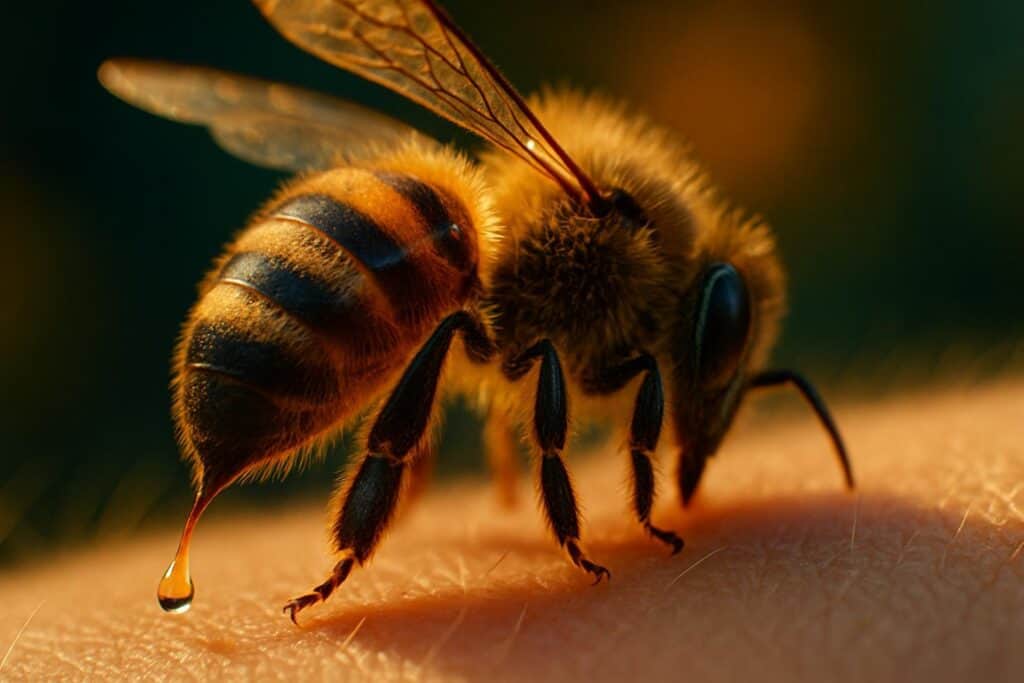
Melittin makes up 50% of dry honeybee venom by weight — and at specific concentrations, it punched 4.4 nm pores into HER2-enriched and triple-negative breast cancer membranes, producing 100% cell death in 60 minutes. One peptide. Two aggressive cancer types. Zero survivors in the dish.
Melittin, a 26-amino-acid peptide and the principal component of honeybee venom, physically ruptures breast cancer cell membranes and simultaneously shuts down the receptor signals those cells use to survive. That finding came from a 2020 study published in NPJ Precision Oncology, conducted by researchers at the Harry Perkins Institute of Medical Research. What surprised the researchers wasn’t just that it worked — it was how fast.
The cells were gone within 60 minutes.
How Melittin Physically Destroys Breast Cancer Cell Membranes
Melittin is positively charged and amphipathic, meaning one end attracts water and the other repels it. That structure lets it embed directly into phospholipid bilayers — the fatty walls surrounding cells. Once there, it assembles into toroidal pores, roughly 4.4 nm in diameter, that punch straight through the membrane.
The cell can no longer hold its internal environment together. It cannot maintain the pressure gradients that keep it functional. Membrane integrity collapses faster than signaling can compensate. The result, under the Perkins Institute’s experimental conditions, was complete destruction of cancer cell membranes within 60 minutes.
Those pores also create a secondary effect: they make it easier for other small cytotoxic molecules to enter the cell, which is why several studies have explored melittin in combination with chemotherapy agents.
How Bee Venom Disrupts HER2 and EGFR Signaling in Breast Cancer
The physical rupture is only part of the mechanism. The Perkins 2020 study also documented that honeybee venom and melittin suppress the activation of receptor tyrosine kinases — specifically EGFR and HER2 — and dynamically reduce their phosphorylation over time.
HER2-enriched and triple-negative breast cancer cells depend heavily on these surface receptors to drive proliferation and survival. Blocking EGFR and HER2 phosphorylation cuts off PI3K/Akt downstream signaling, removing the growth instructions the cells rely on. Melittin also activates caspases and triggers apoptosis, and reviews in MDPI Cancers document additional effects including cell cycle arrest and reduced migration and invasion.
What Lab Results Do and Don’t Tell Us About Bee Venom as a Cancer Therapy
The 100% cell death figure is real — and it is also strictly an in vitro result, achieved at defined concentrations in cultured cells. UCLA Health and peer-reviewed reviews are explicit: melittin remains in the preclinical, experimental stage only.
The challenge is toxicity. At higher doses, melittin is hemolytic — it destroys red blood cells — and increases capillary permeability, which makes systemic delivery in a living body far more complicated than a cell culture dish. Researchers are exploring nanoparticle delivery systems to target melittin more precisely, but that work is ongoing.
The biology is striking. The translation is slow. Both things are true.
—
Somewhere inside a hive, a molecule does something remarkable in a lab dish. Whether it ever does that same thing inside a patient depends on chemistry, engineering, and time. The questions are the right ones. The answers aren’t there yet.
Frequently Asked Questions
What is melittin and where does it come from?
Melittin is a 26-amino-acid peptide that makes up about 50% of honeybee venom by dry weight and is responsible for most of bee venom’s cell-disrupting effects.
How fast does bee venom kill cancer cells in lab tests?
In the 2020 Harry Perkins Institute study, specific concentrations of honeybee venom destroyed HER2-enriched and triple-negative breast cancer cell membranes completely within 60 minutes in vitro.
Does bee venom harm healthy cells?
Under the same experimental conditions, normal mammary epithelial cells showed negligible effects — but higher doses of melittin are hemolytic and can damage healthy tissue, which is a core challenge for any potential therapy.
Is bee venom a cancer treatment?
No. All documented effects are from laboratory and preclinical models. Melittin is not approved or available as a cancer treatment for humans.