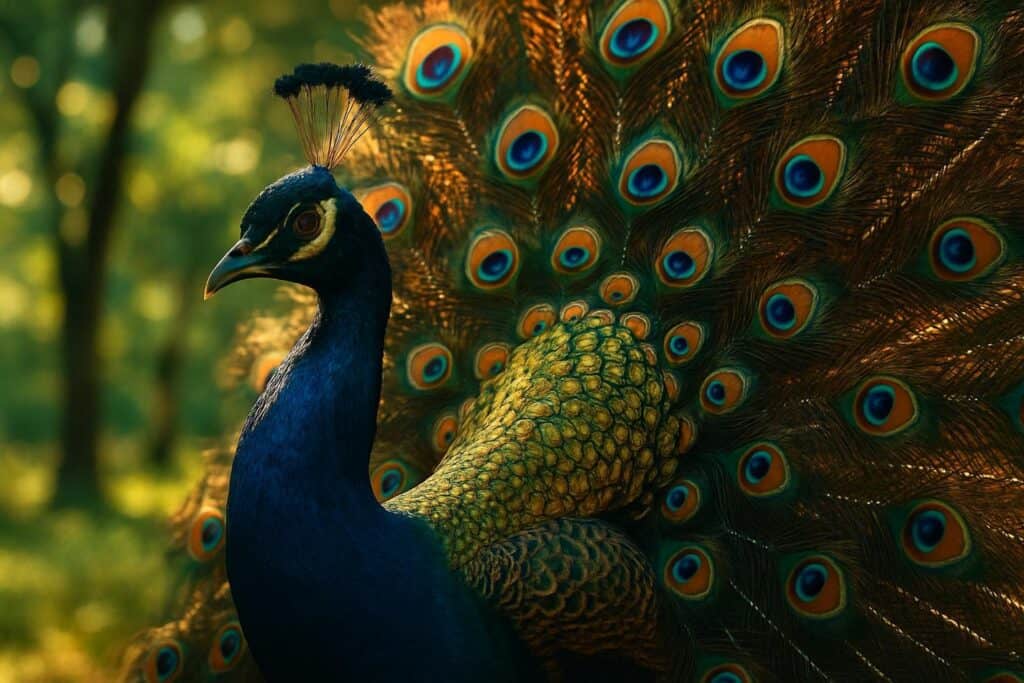
A 140 nm lattice of melanin rods and air channels — not pigment — produces peacock blue. Drop from 9 layers to 4, and the same materials go brown.
Peacock feathers produce their blue and green colors entirely through nanoscale geometry, not pigment chemistry. That discovery reshapes the obvious question: not “what color is the feather?” but “what is the feather actually doing to light?”
Each barbule — a tiny branch off the main feather filament — contains a two-dimensional rectangular lattice of melanin rods embedded in a keratin matrix, with hollow air channels running between them. The lattice constant for blue barbules measures about 140 nm. Green barbules sit at roughly 150 nm. Yellow barbules reach about 165 nm. The same rod-and-channel architecture, shifted by a few dozen nanometers, produces three distinct colors.
Quick Facts
– Blue barbules have a ~140 nm lattice; green ~150 nm; yellow ~165 nm
– 9–12 repeating layers produce blue and green; ~6 layers produce yellow; ~4 layers produce brown
– Melanin rods measure ~120 nm in diameter and up to ~1 µm in length
– Air channels run ~75 nm in diameter; the full photonic stack is ~2 µm thick
– Melanin contributes refractive-index contrast and absorption, not hue
How the Photonic Crystal Mechanism Produces Color
The lattice dimensions are far smaller than a visible-light wavelength, so the color isn’t produced by a simple one-to-one size-to-wavelength match. Instead, the periodic structure creates a partial photonic bandgap, a condition where certain wavelengths of light are strongly reflected and others are not. Blue and green wavelengths exit. Others cancel out through interference.
Melanin matters here beyond just forming the rods. Its refractive index, distinct from the surrounding keratin matrix and the hollow air channels, drives the contrast that makes the interference work. Remove the melanin chemistry and the optical effect collapses.
How Layer Count Controls Color and Why Brown Barbules Are Different
The number of repeating periods changes the reflected color as directly as the lattice spacing does. Blue and green barbules carry 9–12 periods. Yellow barbules carry about 6. Brown barbules drop to roughly 4, and their lattice is less regular — closer to a rectangular arrangement with two different spacings, around 150 nm and 185 nm along two directions, rather than the near-square lattice of the colored barbules.
Fewer periods mean a weaker photonic bandgap and a less saturated, less selective reflection. The brown result isn’t a different material. It’s the same melanin rods and air channels assembled with less regularity and fewer repeats.
This is also why a wet or shadowed peacock visibly shifts color. The effective optical path through the lattice changes with the angle of incoming light, and the bandgap condition shifts with it.
Closing
What looks like a straightforward color is actually a measurement — the feather reporting the exact spacing of its own internal architecture. A 10 nm shift in lattice constant separates blue from green. That sensitivity is built into the structure at the nanoscale, layer by layer, across a stack just 2 µm thick.
The peacock carries a photonic crystal. It just happens to be beautiful.
Frequently Asked Questions
Does a peacock feather contain any blue pigment?
No. Blue, green, and yellow colors in peacock barbules arise from photonic crystal interference, not from any dye or pigment molecule producing those hues.
What makes one peacock feather blue and another green?
Lattice spacing. Blue barbules measure ~140 nm between melanin rods; green barbules measure ~150 nm — a difference of roughly 10 nm.
Why does a peacock’s color change in shadow or when wet?
The photonic bandgap is angle-dependent. Changing the light angle alters which wavelengths meet the reflection condition, visibly shifting the color.
Does melanin play any role beyond forming the rod structure?
Yes. Melanin’s refractive index contrasts with the surrounding keratin matrix and air channels, providing the optical contrast that drives the interference effect.