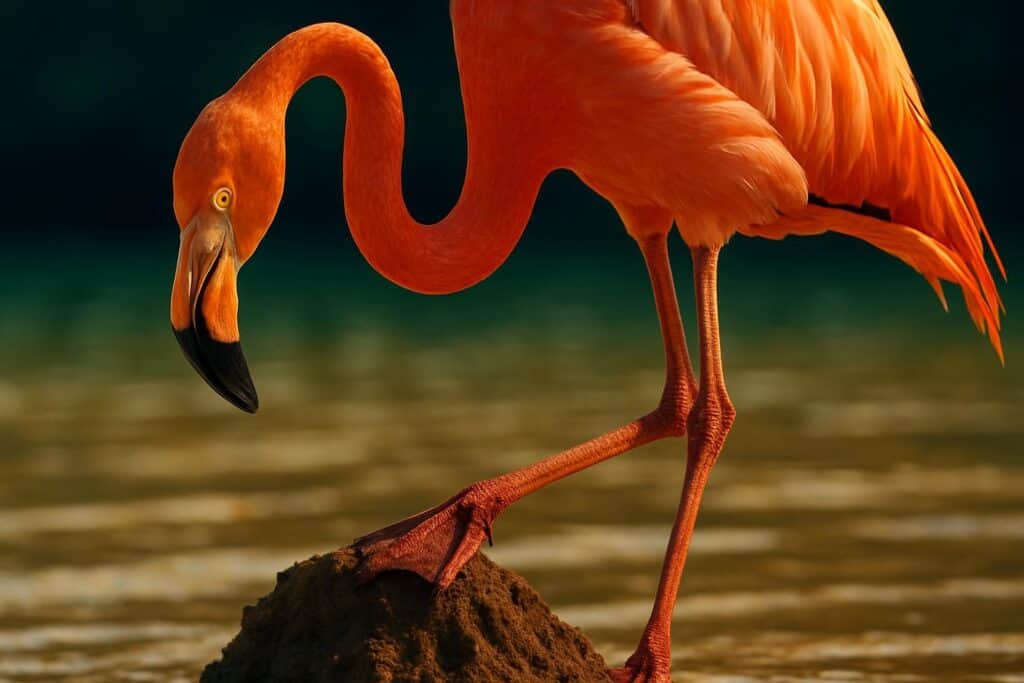
Flamingo nests rise 15–30 cm above the waterline on mud mounds shaped by the birds themselves — and for the first time in roughly a century, wild flamingos have been documented attempting to build them in Florida Bay.
Wild American flamingos have been observed in documented nesting attempts in Florida Bay, likely the first such activity in more than 100 years. That is not a small footnote. These birds were effectively extirpated from Florida by the early 1900s — shot out of the same shallow lagoons where they are now being watched again.
The nearest major source colony sits at Ría Lagartos on Mexico’s Yucatán Peninsula, holding more than 20,000 birds. The Florida Bay groups are small — clusters of 1 to 20 individuals. But small numbers doing the right behavior in the right place is a different story than small numbers passing through.
Why Flamingos Disappeared from Florida Bay in the First Place
The plume trade of the late 19th century targeted wading birds across Florida — egrets, herons, ibises, and flamingos — for feathers sold to decorate fashionable hats. John James Audubon described violent shooting of flamingos in Florida Bay as early as the mid-1800s. By the early 1900s, breeding flamingos were functionally gone from the state.
Habitat loss deepened the wound. Wetland drainage compounded hunting pressure, removing the shallow brackish lagoons flamingos need for both foraging and nesting. For most of the 20th century, flamingos spotted in Florida were assumed to be captive escapees rather than wild birds.
How the Mud Mound Nest Works and What Florida Bay Offers
Flamingos pack wet mud into a cone, typically 15–30 cm tall. That height is enough to keep a single egg clear of minor water-level fluctuations. Both parents take turns incubating; the egg hatches in roughly 27–31 days.
Florida Bay’s shallow, saline waters supply the small invertebrates — brine shrimp, mollusks — that flamingos filter through their specialized bills. Suitable foraging depth and salinity match historical habitat, which is why returning birds are using the same general lagoon system their predecessors occupied, even if exact historical colony sites are not always known.
What Is Actually Driving the Return to Florida
Storms play a role — flamingo sightings in Florida spiked after Hurricane Andrew in 1992 and again after major hurricanes in 2005 and 2017. But storm displacement alone does not explain the pattern. Growing populations at Yucatán and Bahamian colonies mean more birds capable of ranging outward. Everglades restoration and decades without hunting pressure have made Florida Bay genuinely safer habitat.
The mechanism is a combination: regional population growth enabling wider dispersal, stochastic storm events accelerating that dispersal, and protected wetlands waiting on the other end.
The mud mound in Florida Bay is the measurable result of all of that converging at once.
Flamingos are strong fliers. They can cover hundreds of miles. What they apparently could not do, for the better part of a century, was find a Florida coastline where it was safe to stay.
That appears to be changing.
Frequently Asked Questions
Were flamingos ever really native to Florida, or were they just occasional visitors?
Historical records including Audubon’s accounts confirm flamingos were present and likely bred in limited areas of Florida Bay and the Keys before exploitation; they were not abundant statewide, but they were not merely accidental visitors either.
Has confirmed successful flamingo nesting actually happened in Florida yet?
As of 2023–2024, wildlife biologists documented nest-building and courtship behavior consistent with nesting attempts; confirmed fledged chicks and a re-established breeding population are still under active monitoring.
Why did hurricanes bring flamingos back to Florida?
Major storms can displace flamingos from Caribbean colonies and alter their flight paths; flamingo sightings in Florida increased measurably after Hurricane Andrew (1992) and subsequent large hurricanes, though non-storm dispersal from growing colonies also contributes.
How tall is a flamingo nest mound?
American flamingo mud mounds typically measure 15–30 cm in height, occasionally reaching around 40 cm, tall enough to keep the single egg above minor water-level changes.