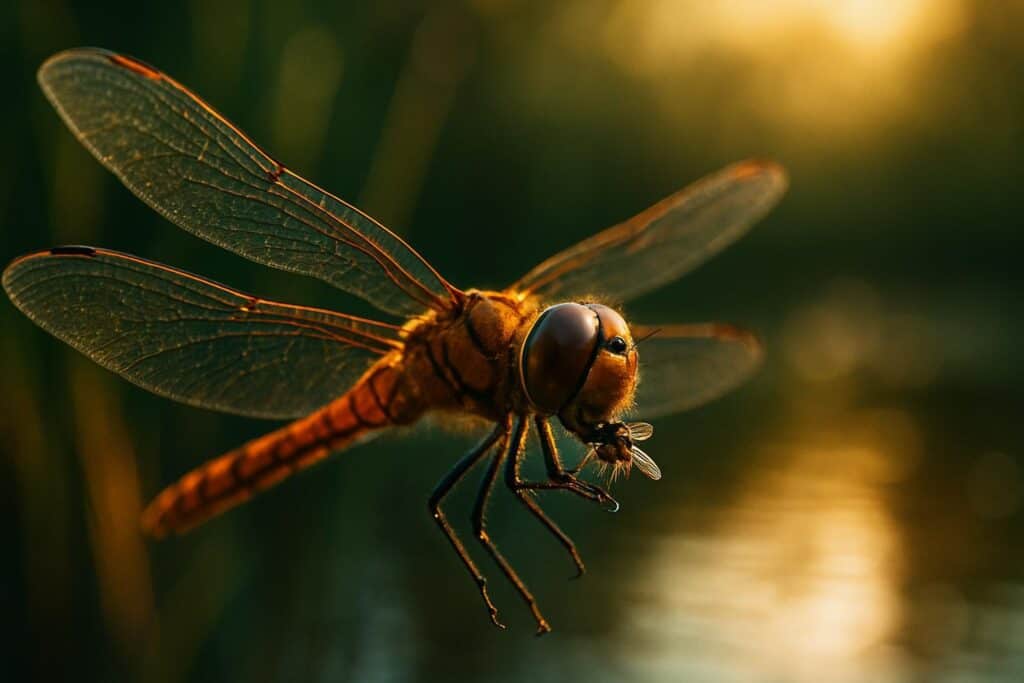
16 specialized neurons encode a full 360° of prey direction — and the entire interception flight is over in 300–600 ms.
Dragonflies don’t chase flying insects — they fly to the empty point in space where the prey will arrive. What makes this stranger is how mechanically sparse the system is. A brain a few millimeters across, 16 neurons, and a capture sequence that closes in well under a second.
The strategy is called constant-bearing navigation. If the prey’s image stays fixed on one spot of the dragonfly’s retina while growing larger, the dragonfly is on a collision course with the prey. The prey’s own flight path becomes the geometry of the trap.
What the 16 Neurons Actually Do During Interception
Eight pairs of target-selective descending neurons (TSDNs) connect the dragonfly’s brain directly to its thoracic flight motors. Together they encode a population vector — direction and speed — covering a full 360° around the animal.
Electrical stimulation of these neurons produces wing movements, confirming they are the steering mechanism, not just observers. TSDNs encode both prey direction and speed as a single vector sent straight to the wings, with no detour through higher processing.
Visual response latency to any drift of the prey’s image off the fovea is roughly 25 ms for head correction and 30 ms for wing adjustment.
The Interception Sequence, Step by Step
When prey enters the field, the dragonfly fires a 50 ms head saccade that snaps the target onto its dorsal fovea — the high-resolution forward strip of its compound eye. About 250 ms of smooth head tracking follows, holding the image steady.
Once the prey passes overhead at the zenith, flight is triggered and interception completes in 300–600 ms. Total time from first saccade to capture spans roughly 600–900 ms.
The dragonfly doesn’t predict a single fixed point and commit blindly. It balances a predictive model of the prey’s path with continuous reactive correction on millisecond timescales, adjusting if the prey turns.
What “Highly Accurate” Actually Means
Popular summaries frequently cite a 95% success rate. Primary literature does not consistently validate that specific figure. Peer-reviewed studies describe dragonfly prey capture as “highly accurate” and visually guided, but success varies by species, prey type, and context.
What is documented: dragonflies apply heuristic selection rules before committing to a flight. Prey angular size and speed must co-vary within a catchable range, or the dragonfly does not launch. This pre-flight filtering is part of why observed interception attempts succeed at high rates — poor-odds flights are screened out before they begin.
Forty years of watching insects, and the dragonfly’s engineering still reads as improbable. Sixteen neurons. A few hundred milliseconds. An empty point in the air that the prey fills right on schedule.
Frequently Asked Questions
How does a dragonfly know where its prey will be?
It uses constant-bearing navigation — keeping the prey’s image fixed on one retinal spot. If that image stays put and grows larger, the dragonfly is on course to intercept without recalculating.
How long does a dragonfly’s interception flight take?
Studies show predatory flights typically last 300–600 ms from takeoff to capture, with the full sequence from first head saccade spanning roughly 600–900 ms.
Is the dragonfly’s 95% success rate real?
Peer-reviewed literature describes dragonfly prey capture as highly accurate but does not consistently confirm 95% as a validated figure; the number appears in popular science summaries rather than primary research.
What are TSDNs in a dragonfly?
Target-selective descending neurons — 16 in total — that encode the direction and speed of prey movement and relay that signal directly to the wing motor centers.