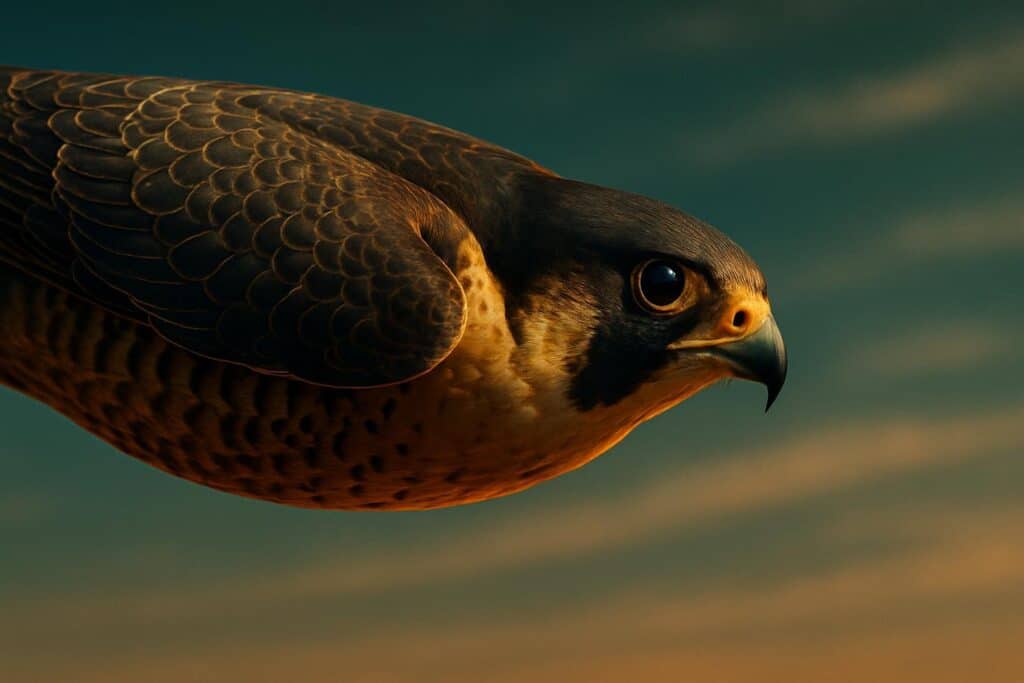
Three wing shapes. One dive. At 179 mph, forces on the wings hit 3× the bird’s body weight — and the pullout takes roughly 2 seconds. The speed is the headline, but the shape-shifting is the actual story.
A peregrine falcon’s stoop is not a fall — it is a sequence of distinct aerodynamic configurations, each triggered by speed. At around 200 mph, the bird has already cycled through three separate body shapes on the way down. That progression, not raw velocity, is what separates a peregrine from a rock dropped from the same height.
The stoop begins high above prey. What follows is a controlled transformation that researchers have documented through high-speed filming, CFD modeling, and aerodynamic analysis — a process that rewrites the bird’s drag profile at every stage.
The Three-Stage Wing Reconfiguration During the Stoop
Below about 190 km/h, a stooping peregrine holds a classical diamond wing shape. The wings spread wide, reading and stabilizing airflow as speed builds.
Between roughly 190 and 240 km/h, the bird tucks its wings into a tighter vertical configuration. Parasite drag drops sharply. The body begins to narrow.
At top velocities — documented at 320 km/h and above — the wings fold completely against the elongated body in what aerodynamicists call the wrap-dive “vacuum pack” configuration. Modeling work indicates this approach achieves a drag coefficient roughly 80% lower than a typical cupped-wing bird posture. The result is a near-teardrop cross-section, maximizing both speed and stability.
How Nasal Tubercles and Vortex Flow Protect the Falcon at Peak Speed
Small bony ridges inside the peregrine’s nostrils create local turbulence that separates incoming air before it reaches the respiratory tract. The mechanism reduces stagnation pressure at the nostril opening — the pressure that, without intervention, could impair breathing or cause barotrauma to lung tissue during a 200 mph descent. These tubercles are a documented anatomical feature, though the full physiological detail is still characterized conservatively in the biological literature.
Steering at these speeds relies on vortex dynamics. Near the end of the stoop, the falcon adopts an M-shaped wing configuration. Vortices from the frontal region, dorsal surface, and tail interact with the main wing vortex in a way that reduces induced drag during pullout, allowing fine pitch and roll correction without bleeding speed prematurely. This is active guidance — simulations show peregrines use something resembling proportional navigation, continuously adjusting trajectory to intercept prey that may be turning or evading.
Closing
The peregrine’s anatomy holds together under forces that reach three times its own body weight, then transitions to controlled level flight within a few seconds. Every structural adaptation — hollow bones reinforced for load-bearing, a powerful shoulder girdle, stiff streamlined feathers — exists to make that transition repeatable.
Speed is what catches the eye. Shape-shifting is what makes it survivable.
Frequently Asked Questions
What is the fastest reliably recorded peregrine falcon dive speed?
The most cited peer-reviewed sources document typical stoop speeds around 320 km/h (~200 mph); one field measurement recorded 389 km/h (242 mph), which remains the highest single reported value.
What are the three wing shapes a peregrine uses during a stoop?
A diamond spread below ~190 km/h, a tight vertical tuck between ~190–240 km/h, and a full wrap-dive where wings press flush against the body above that threshold.
What do nasal tubercles do in a peregrine falcon?
They create turbulence that lowers stagnation pressure at the nostril opening, helping the bird breathe and protecting lung tissue from pressure damage during high-speed dives.
How long does a peregrine’s pullout actually take?
Aerodynamic analysis places the core pullout phase between roughly 2.3 and 3.5 seconds after prey contact, during which vortex-assisted lift helps recover controlled flight with minimal energy loss.