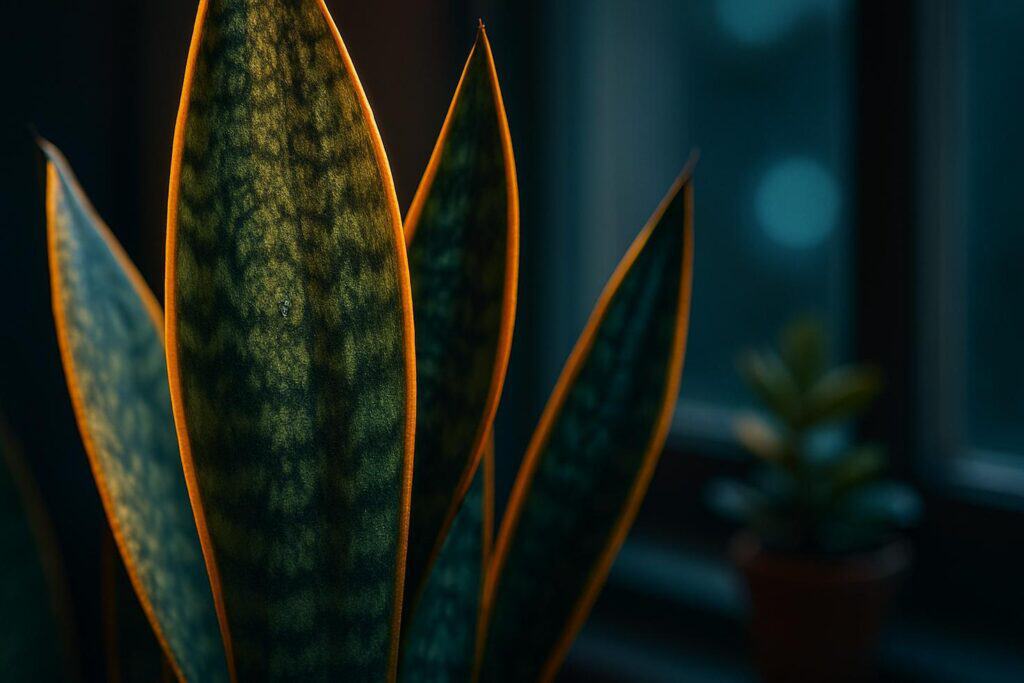
10,000 ppm CO₂ locked inside a sealed leaf — while the stomata stay shut all day, the snake plant runs on fuel it built the night before.
Snake plants fix carbon dioxide at night by opening their stomata in darkness, converting CO₂ into malic acid, and storing it in their leaf vacuoles until daylight. That reversal of the typical plant schedule is not a curiosity — it is a full metabolic strategy called Crassulacean Acid Metabolism, or CAM. While a spider plant or pothos sits idle in the dark, the snake plant is actively loading its cells with tomorrow’s carbon supply.
The mechanism behind this is an enzyme called phosphoenolpyruvate carboxylase, or PEPC. It grabs CO₂ at night and binds it into four-carbon organic acids, primarily malate. By morning, the stomata seal shut. The plant then breaks down that stored malate, flooding the leaf interior with CO₂ that can reach concentrations around 10,000 ppm — roughly 25 times the concentration in outdoor air.
Quick Facts
– Snake plants are CAM succulents; stomata open at night, seal during the day
– Stored CO₂ inside the leaf during daytime decarboxylation can reach ~10,000 ppm
– Oxygen release is tied to daytime light reactions, not to nighttime CO₂ uptake
– CAM reduces water loss by roughly an order of magnitude compared to non-CAM plants
– CAM occurs in an estimated 5–10% of all plant species
What Happens Inside a Snake Plant Leaf During the Night
Cooler nighttime temperatures and higher humidity lower the cost of opening stomata — water escapes more slowly when vapor pressure deficit is reduced. The snake plant exploits that window. PEPC pulls CO₂ into the leaf and locks it as malic acid inside large vacuoles. Those vacuoles are a structural feature of CAM succulence: big enough to hold both water and acid reserves through the entire dark period.
This nocturnal fixation runs across the whole dark interval, which spans roughly 8–12 hours depending on photoperiod and conditions. By the time light arrives, the storage tanks are full.
How the Snake Plant Uses Stored CO₂ During the Day
When daylight hits, the light-dependent reactions power up — but the stomata stay closed. The plant decarboxylates its stored malate, releasing CO₂ internally. Rubisco then uses that concentrated supply to drive the Calvin cycle and produce sugars. Because the internal CO₂ is so high, photorespiration is suppressed and carbon fixation runs efficiently — all without drawing a single molecule from the surrounding air.
This is why daytime transpiration in CAM plants drops sharply: no open stomata means almost no water loss. Across CAM species broadly, that reduction reaches roughly an order of magnitude compared with non-CAM plants under similar conditions.
The Oxygen Misconception About Snake Plants
A widely repeated claim holds that snake plants pump out oxygen all night. The mechanism does not support that. Oxygen evolution is coupled to light-driven electron transport in the chloroplasts, which requires photons. At night, the snake plant respires like any other plant — consuming oxygen and releasing CO₂ — while simultaneously fixing some of that CO₂ into malate via PEPC. Net oxygen release at night is minimal or negative. The oxygen credited to the snake plant is real, but it arrives during the day.
The snake plant does not break any laws of biology. It just runs the schedule backward. Night is intake; day is output — and the leaf surface reveals nothing either way.
Frequently Asked Questions
What is CAM photosynthesis in snake plants?
CAM is a metabolic strategy where stomata open at night to fix CO₂ into malic acid, which is stored and used as an internal carbon source during the day with stomata closed.
Do snake plants really release oxygen at night?
No — oxygen evolution requires light-driven reactions. At night, snake plants fix CO₂ into acids; actual oxygen release occurs during daylight hours.
How concentrated does CO₂ get inside a snake plant leaf?
During daytime decarboxylation, internal CO₂ can reach approximately 10,000 ppm — about 25 times the concentration in outdoor air.
Why do snake plants need so little water?
Closed daytime stomata drastically reduce transpiration. CAM plants broadly can lower water loss by around an order of magnitude compared with non-CAM plants.