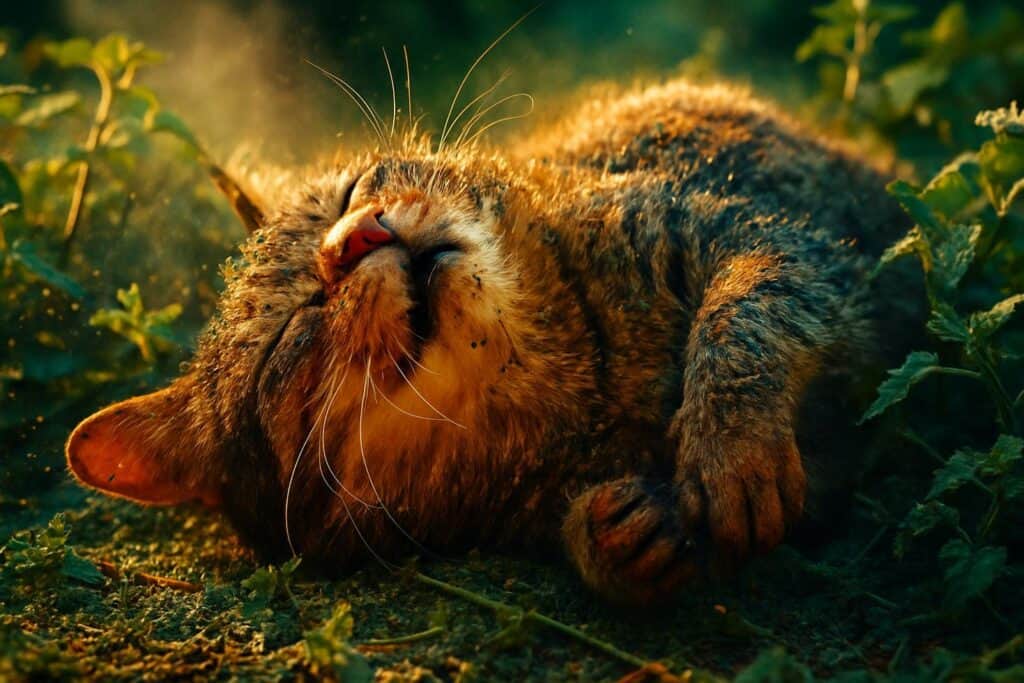
Catnip’s one volatile oil triggers elevated endorphins in cats — and documented mosquito avoidance in the same moment. The cat rolls. The mosquito leaves.
Nepetalactone, the volatile terpenoid in catnip’s crushed leaves, produces euphoria in cats and drives mosquitoes away — through entirely different mechanisms, in the same backyard, at the same time. That contrast is not a coincidence or a side effect. It reflects how the same molecule hits completely different receptor systems in two very different nervous systems.
When a cat crushes catnip leaves by rolling, it releases a stronger pulse of nepetalactone. The oil binds to nasal receptors, signals travel to the amygdala and hypothalamus, and blood tests on exposed cats show measurably elevated endorphin levels. Mosquitoes detect the same compound through antennal olfactory receptors — and move away from treated surfaces.
How Nepetalactone Affects a Cat’s Brain and Body
When a susceptible cat sniffs crushed catnip, nepetalactone mimics feline pheromones — particularly sexual pheromones — activating brain regions tied to emotion and instinct. Research summarized in Science confirmed that iridoids activate cats’ endogenous opioid system, producing the rolling, rubbing, and vocalizing that looks, behaviorally, a lot like euphoria.
Ingesting catnip tends to produce a calming effect rather than stimulation. Sniffing it does the opposite. The molecule is the same; the delivery route changes the output.
How the Same Molecule Repels Mosquitoes
Mosquitoes detect nepetalactone through olfactory receptors on their antennae. Experiments confirm that surfaces treated with catnip iridoids see reduced mosquito landing and biting compared to untreated controls. The plant produced these compounds specifically as anti-herbivore defenses — volatile chemicals concentrated in damaged leaf tissue to discourage insects from feeding.
When a cat rolls in catnip and coats its fur, it is inadvertently applying a plant insect deterrent — a behavior that may carry adaptive value, though the exact magnitude of protection and how long it persists on fur has not been quantified in published sources.
Closing
One molecule. Two receptor systems. Two behavioral outcomes separated by everything evolution has done to cats and mosquitoes since their lineages diverged. The plant never aimed at either of them. It just made a chemical that works differently depending on who shows up.
Frequently Asked Questions
Why do only some cats respond to catnip?
The response is genetic. About 60% of domestic cats carry the trait; kittens and some older cats typically don’t react regardless.
How long does a catnip reaction last in cats?
Most reactions last 10–15 minutes. After that, cats enter a refractory period lasting roughly 30 minutes to 2 hours before they can respond again.
Does catnip actually repel mosquitoes, or is that just a claim?
Controlled experiments confirm mosquito avoidance of surfaces treated with catnip iridoids. The precise repellency strength relative to synthetic repellents like DEET varies by study conditions and has not been established as a single reliable figure.
Is nepetalactone safe for cats?
Veterinary sources consider catnip non-toxic and non-addictive for cats at normal exposure levels. Large ingested amounts may cause temporary digestive upset.