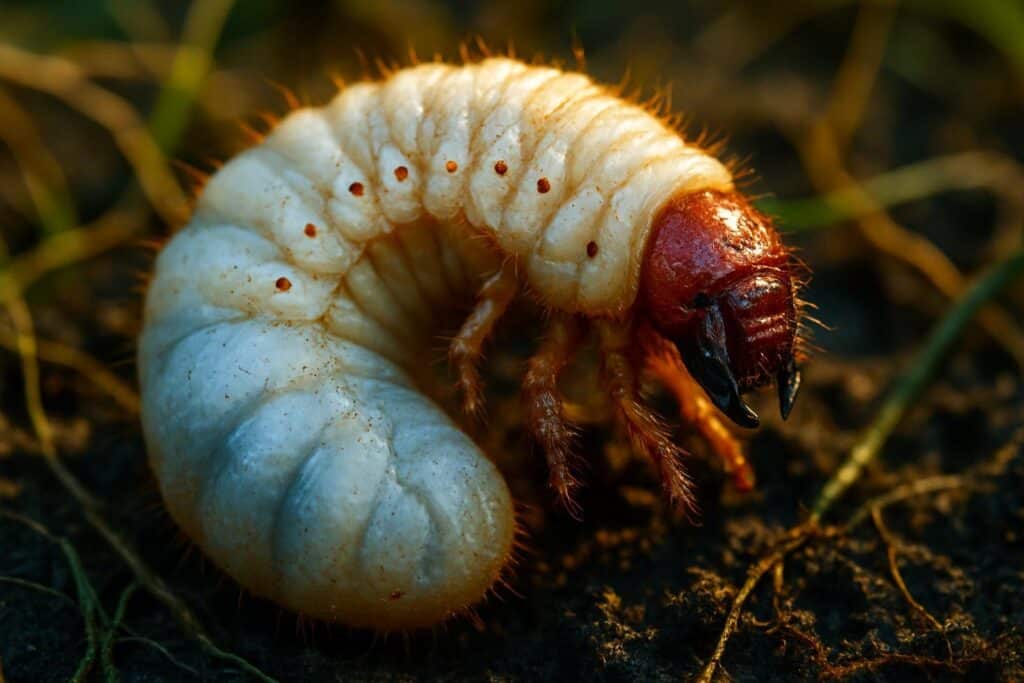
One infected Japanese beetle grub seeds surrounding soil with new spores as it breaks down — and Purdue Extension confirms the inoculum builds across multiple seasons of application.
Milky spore — the commercial formulation of Bacillus popilliae / Paenibacillus popilliae — is a host-specific bacterial pathogen that kills Japanese beetle grubs and then uses their decomposing bodies to spread further through the soil. That biological loop is genuinely strange to watch unfold. A grub ingests spores, the bacterium multiplies inside the host, and the dying larva becomes a release point for the next round of infection.
What makes this mechanism compelling is that it funds its own expansion. Each dead grub seeds the surrounding soil, and the next grub to pass through that patch encounters a denser spore population than the one before it.
Quick Answer
- Milky spore bacteria infects Japanese beetle grubs after ingestion, killing the host as it multiplies inside.
- The decomposing grub releases spores back into the soil, which can infect future grubs in the same area.
- Purdue Extension confirms multiple applications over several seasons are typically needed to build effective soil inoculum.
- Commercially available milky spore products are active only against Japanese beetle grubs — not other white grub species.
- Claims of decade-long protection come from commercial sources and are not corroborated by university extension research.
How the Milky Spore Infection Cycle Actually Works
A grub feeds on grass roots and swallows spores already present in the soil. The bacterium then multiplies inside the larva. The grub’s body becomes a spore-production environment before it dies and breaks down. As decomposition proceeds, new spores release into the surrounding soil and persist, waiting for the next susceptible host to pass through.
This is a real, extension-verified mechanism. The promotional figure of “up to two billion spores per grub” appears in commercial materials but is not confirmed by Purdue or Illinois Extension sources, so that specific number should be read as marketing rather than science.
Why Milky Spore Requires Multiple Seasons, Not a Single Application
Purdue Extension is direct on this point: commercially available milky spore products have not proven effective as a stand-alone, single application. Building meaningful inoculum takes repeated treatments across several seasons.
The accumulation logic still holds — each application stacks onto prior seasons’ deposits — but the timeline is gradual, not dramatic. Post-application irrigation is also recommended by Purdue to help the product establish. Any source promising ten or more years of protection from one treatment is not reflecting extension-verified evidence.
What the Research Actually Supports About Biological Grub Control
Milky spore’s core advantage is host specificity. It targets Japanese beetle grubs without the broader effects of synthetic insecticides.
A peer-reviewed turf trial using a different bacterial pathogen, Serratia entomophila, showed that a bacterial grub control agent can establish in lawn soil within one month of application, with 46% of larvae showing infection in treated plots. That study doesn’t validate milky spore’s persistence claims, but it confirms the broader principle: entomopathogenic bacteria can self-establish in turf systems under field conditions.
Frequently Asked Questions
What grubs does milky spore actually control?
Commercially available milky spore products are active only against Japanese beetle grubs, according to Purdue Extension.
How long does milky spore take to work?
Purdue Extension describes it as a multi-season soil buildup process requiring repeated applications — not a single-treatment solution.
Does milky spore last for ten or fifteen years?
That claim originates from commercial sources. University extension research does not corroborate decade-long persistence from standard applications.
Does milky spore need water after application?
Yes. Purdue Extension recommends post-application irrigation for milky spore and similar biological insecticides.