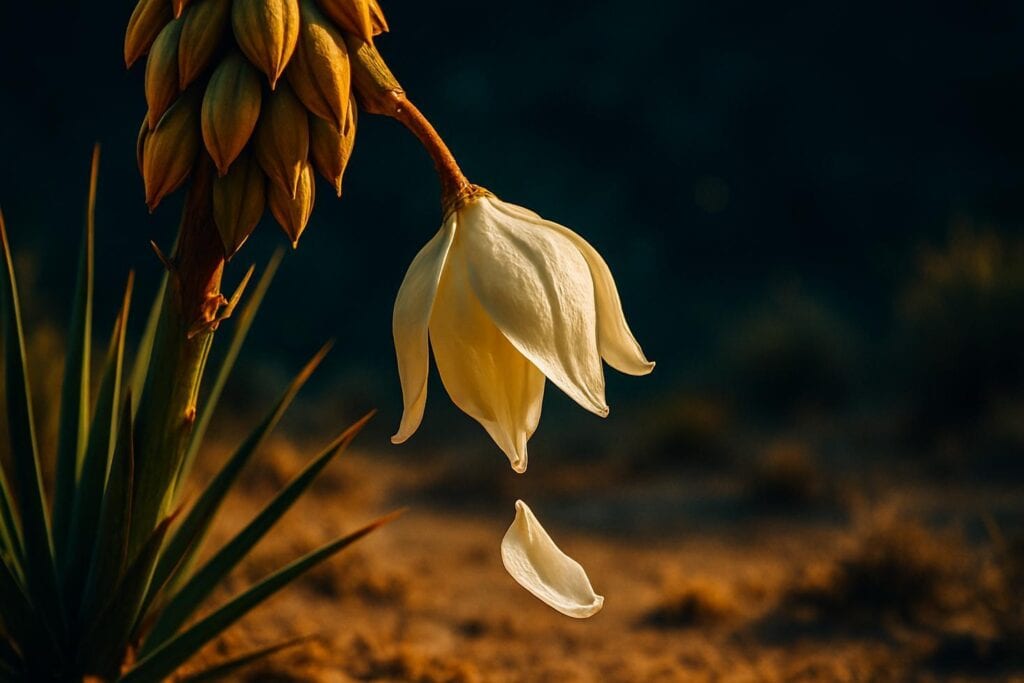
One yucca flower, one wrong egg count — the plant drops the entire bloom, larvae and all. The enforcer was never the moth.
Yucca plants selectively abort their own flowers when a moth’s egg load in the ovary grows too large, killing every larva inside the fallen bloom. That’s not a defense reflex. It’s a biological contract being actively maintained. The plant participates in one of the most tightly coupled mutualisms in North American ecology — and it holds the other party accountable.
The yucca moth is the sole pollinator of yucca flowers. She collects pollen deliberately, packs it, and carries it to the next bloom. In exchange, the plant tolerates a small number of her eggs hatching inside the ovary, where larvae feed on developing seeds. That tolerance has a hard ceiling.
Quick Answer
- Yucca plants practice selective floral abscission — deliberate flower drop triggered by excessive egg loads.
- The dropped bloom takes every larva inside it down with it; none survive.
- Yucca moths are the only pollinators yucca flowers have, making this a two-sided dependency.
- The plant enforces limits on larval seed consumption to protect its own reproductive output.
Why Yucca Plants Abort Flowers Loaded With Too Many Eggs
When egg load in a flower’s ovary crosses a threshold, the plant’s abscission response is triggered and the flower detaches entirely. Selective abscission targets over-exploited flowers specifically. Flowers carrying a modest egg load are left to develop normally. The larvae inside those survive, feed on seeds, and eventually pupate. The mechanism sorts blooms by egg damage rather than cutting everything indiscriminately.
This is what makes it mutualism enforcement rather than simple defense. The plant isn’t eliminating the moth population — it’s capping the cost each individual moth is allowed to impose.
What Keeps This Mutualism Stable Over Evolutionary Time
Both species need the relationship to survive. Without moth pollination, yucca seeds don’t form at all. Without yucca seeds, moth larvae starve. Neither partner can defect entirely without collapsing its own reproduction. That mutual dependency is the foundation. Floral abscission is the mechanism that stops one side from exploiting the other into extinction.
Researchers and ecologists, including historical work tracing back to Charles Valentine Riley’s 19th-century observations, have documented this as one of the clearest examples of mutualism policed by the plant partner. The USDA Forest Service and peer-reviewed ecology literature both describe the abscission response as a key stabilizing feature of the interaction.
Closing
The yucca doesn’t negotiate. It aborts flowers that cost too much and sustains the ones that don’t. That quiet arithmetic has kept both species reproducing across millions of years. The oldest agreements in nature tend to be the ones with built-in consequences.
Frequently Asked Questions
How does a yucca plant detect too many moth eggs?
Egg-laying by the moth damages ovule tissue in the flower’s ovary; the extent of that damage appears to trigger the plant’s abscission response when it exceeds a threshold.
Do all the larvae die when a yucca drops a flower?
Yes. Floral abscission removes the bloom entirely, and larvae inside have no way to survive or relocate before the flower falls.
Can yucca flowers be pollinated without moths?
No. Yucca moths are the obligate and exclusive pollinators of yucca flowers; no other species performs this function.
Is this behavior harmful to yucca moth populations overall?
Not under normal conditions. Abscission targets individual over-loaded flowers while leaving moderately-loaded blooms intact, preserving enough larval survival to sustain the moth population.