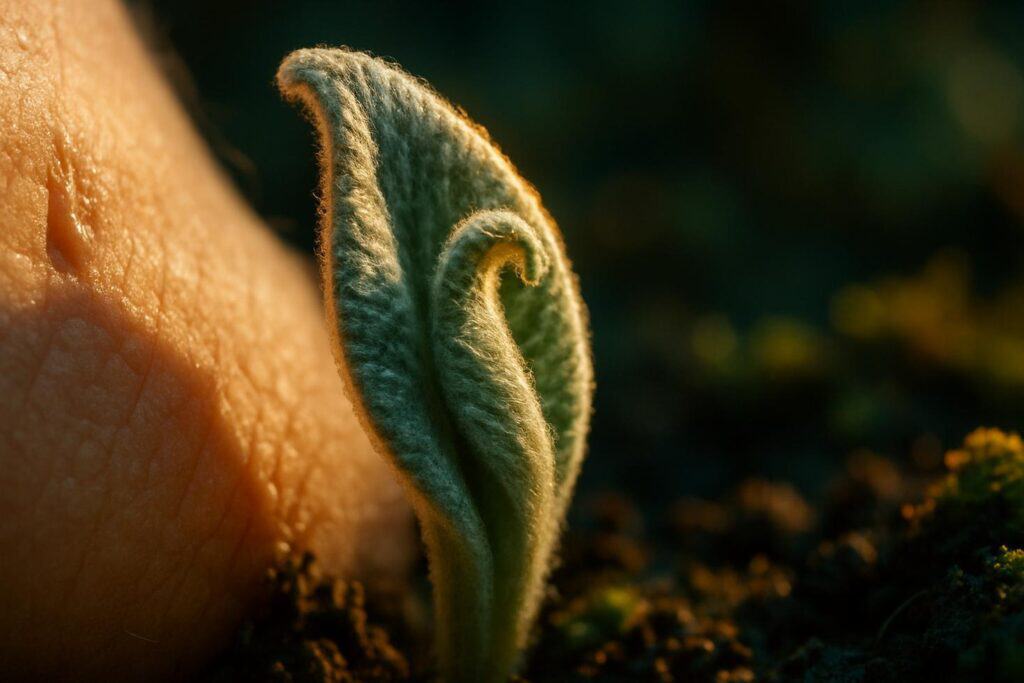
Dense silver trichomes physically hold fluid against a wound — then tannins contract the surrounding tissue, then flavonoids attack vancomycin-resistant bacteria. Three mechanisms. One velvet leaf.
A Lamb’s Ear leaf (Stachys byzantina) functions as a wound dressing through two distinct, simultaneous physical and chemical systems. Most people grow it because it feels like velvet. What’s happening at the leaf surface is considerably stranger than that.
The dense layer of trichomes — the fine silver hairs covering every surface — creates a fibrous scaffold. That structure holds blood and wound fluid pressed against the skin while the body begins its own repair underneath. That’s the physical layer. The chemical layer starts working at the same time.
How Lamb’s Ear Trichomes and Tannins Act on a Fresh Wound
Tannins in the leaf tissue provide an astringent effect: they cause surrounding tissue to contract, reducing secretions and slowing bleeding from minor cuts. Tannin-driven tissue contraction speeds wound closure and simultaneously limits the surface area available for microbial entry. The trichomes don’t contribute antibacterial action directly. Their job is structural — holding plant juices and wound exudate on the wound surface long enough for the chemistry to work.
The Antimicrobial Compounds in Stachys byzantina
Alongside tannins, Lamb’s Ear contains flavonoids, iridoids, and alkaloids including betonicine and trigonelline. Flavonoids and phenolic acids show antioxidant, anti-inflammatory, and antimicrobial activity. Research cited by Medicinal Herb Info and GardensAll reports that Stachys byzantina extracts show measurable antimicrobial activity against vancomycin-resistant strains of Staphylococcus aureus — a Gram-positive bacterium that defeats one of medicine’s last-resort antibiotics. This is peer-reviewed finding, not herbal folklore.
What the Traditional Use Record Actually Shows
Lamb’s Ear has a long history as a natural wound dressing across traditional medicine systems, used as a bandage, poultice, and wash. The precise depth of that history is genuinely unclear — claims of “1,000 years of battlefield use” and soldiers carrying leaves into medieval combat are not documented in historical scholarship. They appear to be modern extrapolations from the plant’s known properties. Similarly, a figure circulating online that the leaves absorb “three times their weight in liquid” has no quantitative measurement behind it. Sources consistently describe the leaves as highly absorbent, but no controlled study has produced a specific ratio.
The real record is still interesting without those embellishments. Traditional herbalists recognized this plant as vulnerary — wound-healing — and astringent, and the phytochemical research confirms a plausible mechanism for both properties.
A field plant that physically scaffolds a wound, chemically contracts tissue, and then chemically suppresses resistant bacteria is not a coincidence of texture. It’s three overlapping mechanisms that happen to arrive together in one leaf. The velvet surface is just where it starts.
Frequently Asked Questions
What makes Lamb’s Ear leaves absorbent?
Dense trichomes (fine surface hairs) create a fibrous layer that traps and holds moisture and wound fluid against the skin.
What causes the astringent or blood-slowing effect?
Tannins in the leaf tissue cause surrounding tissue to contract, which reduces secretions and can slow minor bleeding.
Does Lamb’s Ear actually kill antibiotic-resistant bacteria?
Lab research shows Stachys byzantina extracts have antimicrobial activity against vancomycin-resistant Staphylococcus aureus, though this hasn’t been tested in clinical wound-care trials.
Did medieval soldiers really use Lamb’s Ear as a battlefield bandage?
This claim is not documented in historical scholarship. Traditional wound-dressing use is confirmed; the specific battlefield-and-timeframe story is unverified modern folklore.