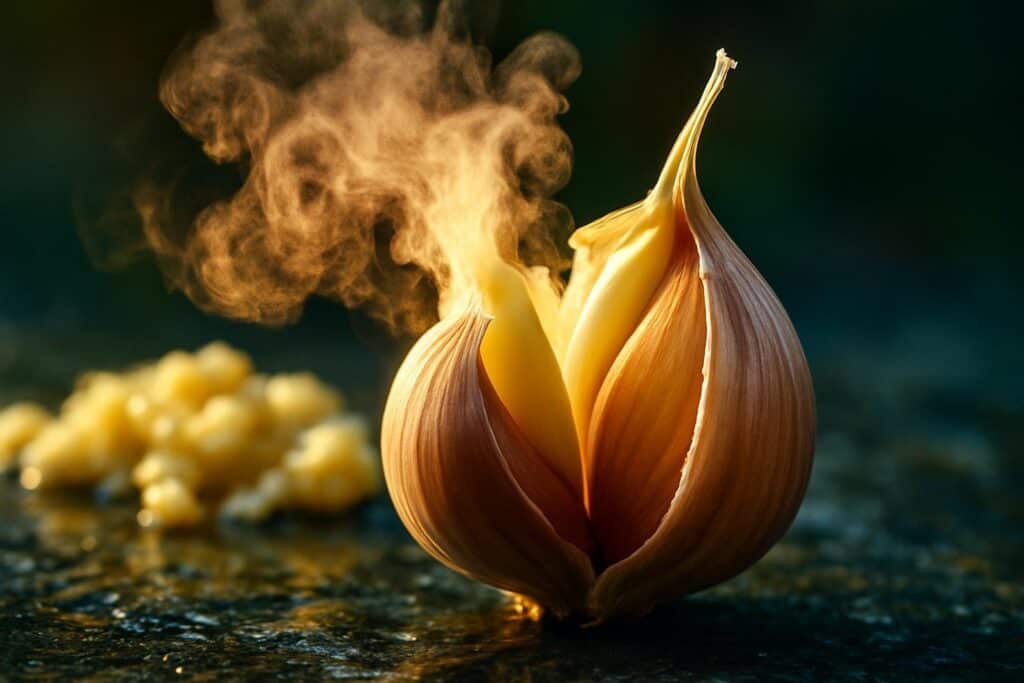
A single clove — 84% water — releases allicin within seconds of crushing. That compound kills certain bacteria at 1 part per 250,000 dilution.
When a garlic clove is crushed, an enzyme called alliinase converts a stored compound called alliin into allicin — one of the most potent natural antimicrobials ever documented. That reaction begins within seconds. What’s remarkable is that the clove doing this is, by weight, more than 84% water.
The two reactants — alliin and alliinase — are held in separate compartments inside intact garlic cells. Damage the tissue, and they meet. The chemistry is immediate. That sharp, electric bite in the air after a knife comes down is the defense system already working, not announcing itself.
Garlic has been in human hands for roughly 6,000 years, with documented use appearing in ancient Egypt, China, India, and Japan. The Ebers Papyrus, dating to before 1500 BC, records medicinal applications. The full chemical picture is still being mapped.
The Alliinase Reaction: How Garlic Assembles Allicin
Intact garlic cells keep alliin — a sulfur-containing amino acid derivative — physically separated from alliinase, the enzyme that acts on it. The separation is structural. When cell walls rupture from crushing or chopping, the two compounds mix with the cell’s water content, and the conversion to allicin begins.
Allicin is a thiosulfinate: colorless, oily, and chemically unstable. Allicin’s instability is part of its mechanism — it rapidly transforms into other organosulfur compounds including ajoene, diallyl polysulfides, and vinyldithiins, each with their own biological activity. Fresh preparations have meaningfully different chemistry than stored or aged ones.
Allicin’s Antimicrobial Potency at Extreme Dilution
Allicin was first isolated in 1944. Laboratory studies have since documented its antibacterial activity against both Gram-positive and Gram-negative bacteria at dilutions between 1:85,000 and 1:250,000. Those figures come from in vitro testing, meaning controlled lab conditions rather than soil or clinical environments.
That dilution range is worth pausing on. One part allicin per 250,000 parts solution still demonstrates measurable antibacterial effect. The source material producing it is a clove that weighs roughly 3 to 5 grams and is mostly water.
Garlic’s organosulfur compounds also show antifungal, antiprotozoal, antioxidant, and several other pharmacological activities in animal and human research. The clove’s evolutionary function is defensive — producing secondary metabolites to deter herbivores and pathogens — not to serve as a growth signal for other organisms.
Closing
Six thousand years of human use, and the mechanism behind garlic’s smell wasn’t isolated until 1944. A compound assembled in seconds from a mostly-water clove still stops bacteria dead at concentrations almost too thin to picture. Some of the most powerful chemistry in nature hides inside the most ordinary-looking ingredients.
Frequently Asked Questions
What enzyme activates when garlic is crushed?
Alliinase activates when garlic cells are damaged, converting alliin into allicin within seconds.
How dilute can allicin be and still kill bacteria?
In vitro studies document antibacterial activity at dilutions between 1:85,000 and 1:250,000.
How long has garlic been used medicinally?
Approximately 6,000 years, with records appearing in the Ebers Papyrus before 1500 BC.
Why does crushed garlic smell stronger than a whole clove?
Crushing ruptures cell walls, allowing alliinase and alliin to meet and react, producing allicin — the volatile compound responsible for garlic’s sharp odor.