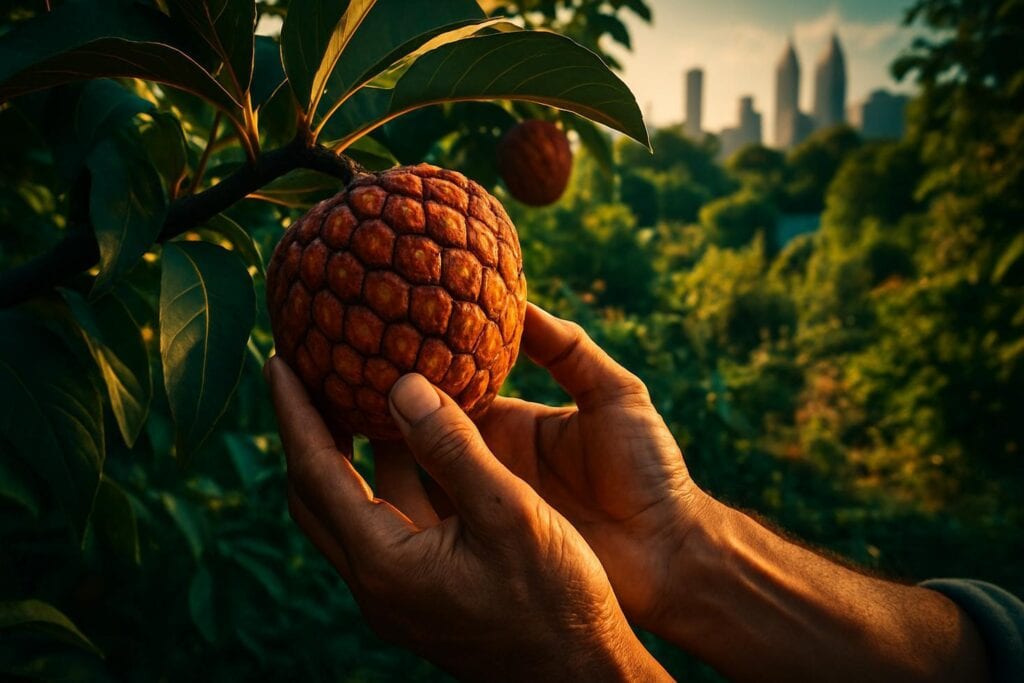
Atlanta’s Browns Mill site turned 7.1 vacant acres into over 2,500 free edible and medicinal plants — in a neighborhood where one-third of residents live below the poverty line.
A 7.1-acre parcel in southeast Atlanta now holds what city officials and partner organizations describe as the largest public food forest in the United States. The land sits inside Browns Mill Park, four miles south of Atlanta’s city center, and every plant on it is free to pick — no fee, no membership, no bus transfer required. That last point matters, because before this project opened, the nearest supermarket required about a 30-minute bus ride.
The site was not always vacant. The Conservation Fund’s records identify it as a former family farm owned by Willie and Ruby Morgan, who reportedly left surplus produce on neighbors’ fence posts. It sat dormant before the Conservation Fund purchased it in 2016, and Atlanta City Council approved its transformation into a public food forest that same year.
How the Agroforestry Design at Browns Mill Actually Functions
The planting structure follows a layered agroforestry model: tall fruit and nut trees form a canopy, berry shrubs occupy the understory, and herbs and groundcovers fill the gaps below. Existing woody perennials — a pecan orchard, black walnut trees, muscadine grapes, and blackberry brambles — provided the initial framework. Fruit trees, shrubs, and mushrooms were added in phases.
Layered canopy over ground-level edibles drives the productivity here. As of 2021, Agritecture reported that roughly 2.5 of the 7.1 acres had been activated, with approximately 4 more acres still in development — meaning plant counts will continue to rise.
Who Funded and Built the Browns Mill Food Forest
Federal dollars supplied roughly half the early capital. The USDA Forest Service’s Community Forest Program contributed approximately $86,000, with total federal funding reaching $164,000 according to the Atlanta Journal-Constitution. The city purchased the property from The Conservation Fund for $157,384. Trees Atlanta contributed $121,500 for part-time staff, including a food forest ranger and a community workforce educator. More than 1,000 volunteers help maintain the site.
The city also created a trust fund for community outreach. Before 2014, growing food on residential lots in Atlanta was illegal — a zoning shift that made urban food access possible — so this project reflects a genuine policy reversal, not just a planting program.
Closing
The Morgan farm once fed this neighborhood informally. The food forest formalizes that same logic at municipal scale: free produce, public land, no intermediary. The soil, as it turns out, does not care who holds the deed.
Frequently Asked Questions
What can people pick at the Atlanta Urban Food Forest at Browns Mill?
Visitors can take fruits, nuts, vegetables, herbs, and mushrooms free of charge; specific species include pecans, black walnuts, muscadine grapes, and blackberries.
Is the Browns Mill Food Forest really the largest in the United States?
City officials, the USDA, The Conservation Fund, and multiple partner organizations describe it as the largest public food forest in the country, though that status is based on reported rather than formally audited figures.
When did the Browns Mill Food Forest open to the public?
Agritecture reports the site opened as a community urban food forest at the start of 2021, though planning and planting began after city council approval in late 2016.
Are the plants at Browns Mill grown without pesticides?
Yes — multiple sources, including Modern Farmer and Harvest Savvy, describe the plantings as pesticide-free.