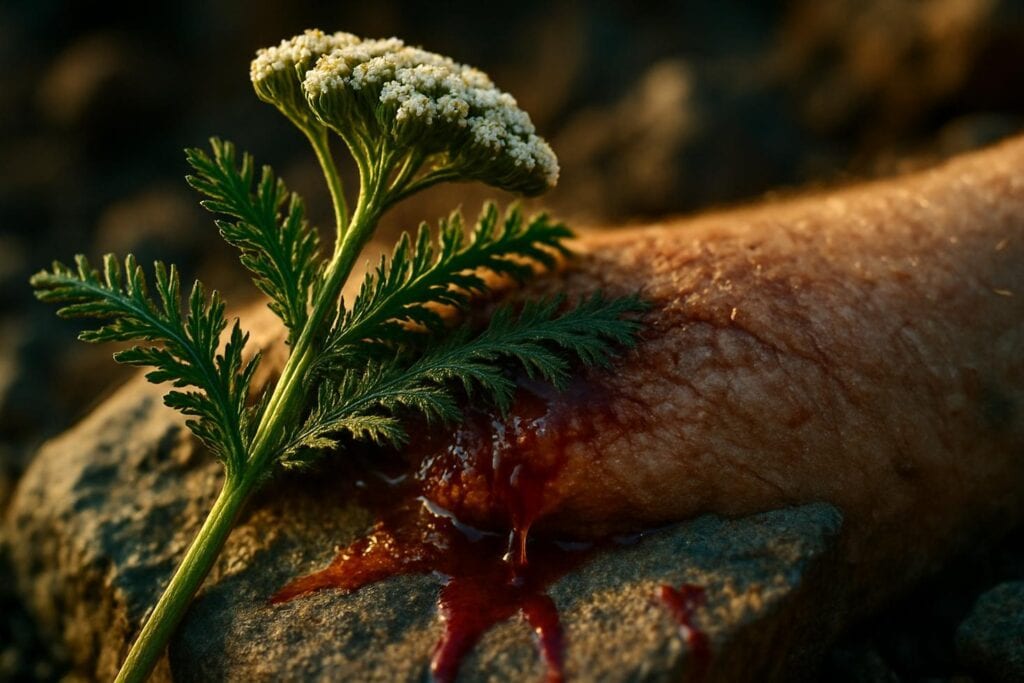
Yarrow’s tannins cause local vasoconstriction and tissue contraction — a lawn perennial that earned the name Herba militaris across Greek, Roman, and medieval traditions.
Achillea millefolium, the yarrow plant common in lawns and meadows, has documented hemostatic and wound-healing properties when its leaves are crushed and applied to minor cuts and scrapes. That’s not folklore — it’s supported by herbal monographs, ethnobotanical records, and phytochemical analysis. What makes the story striking is the timeline: yarrow was recorded as a wound herb by Dioscorides in the 1st century CE, carried through Roman and medieval European medicine, and is still characterized as styptic and vulnerary in modern herbal literature.
Soldiers knew it as Herba militaris — the military herb — long before anyone isolated the compounds responsible.
How Yarrow’s Phytochemicals Act on a Wound
Crushing yarrow leaves releases several classes of active compounds simultaneously. Tannins and other astringent molecules cause local tissue contraction and constriction of small blood vessels near the skin’s surface. This mechanical effect is what gives yarrow its styptic reputation — and why folk practice included inserting a leaf into a nostril to stop a nosebleed.
Azulene, the compound that turns yarrow essential oil a distinctive blue, reduces inflammation and stimulates tissue formation during the healing phase. Volatile oils including cineole add antimicrobial action, addressing infection risk — the other major danger of a battlefield wound.
Yarrow’s Place in Documented Military and Medical History
Dioscorides, writing in the 1st century CE, described a plant identified with yarrow as being ground up and applied to bleeding wounds to close them and reduce hemorrhage. That record places confirmed use at roughly 2,000 years ago. Roman, medieval, and Anglo-Saxon herbals continued documenting yarrow as a vulnerary and hemostatic through successive centuries.
The Achilles legend — that the Greek hero used yarrow on soldiers’ wounds at Troy — is mytho-historical rather than archaeologically verified. The genus name Achillea reflects that legend, not confirmed Bronze Age practice. What is verifiable is the Herba militaris epithet appearing across classical and later sources, consistently tied to the plant’s role in stopping battlefield bleeding.
Closing
Yarrow is still listed as styptic, vulnerary, and antimicrobial in current herbal monographs. The phytochemistry now explains what centuries of field observation had already established. A plant that colonizes disturbed ground — including lawns — turned out to carry a functional wound-care toolkit in its feathery leaves. The soldiers who packed it weren’t wrong. They were just working from data the laboratory hadn’t caught up to yet.
Frequently Asked Questions
What does yarrow actually do to a wound?
Crushed yarrow leaves release tannins and astringent compounds that cause local vasoconstriction and tissue contraction, slowing superficial bleeding and supporting scab formation.
Is the Achilles story about yarrow historically accurate?
The Achilles connection is a legend repeated across classical sources, not an archaeologically verified fact. The genus name Achillea millefolium derives from that legend.
How long has yarrow been used as a wound herb?
Yarrow is documented as a wound herb from at least the 1st century CE through Dioscorides, with continuous recorded use through Roman, medieval, and Anglo-Saxon traditions.
What gives yarrow its anti-inflammatory wound properties?
Azulene in yarrow’s essential oil reduces inflammation and stimulates tissue formation; salicylic acid provides additional mild analgesic and anti-inflammatory effects.