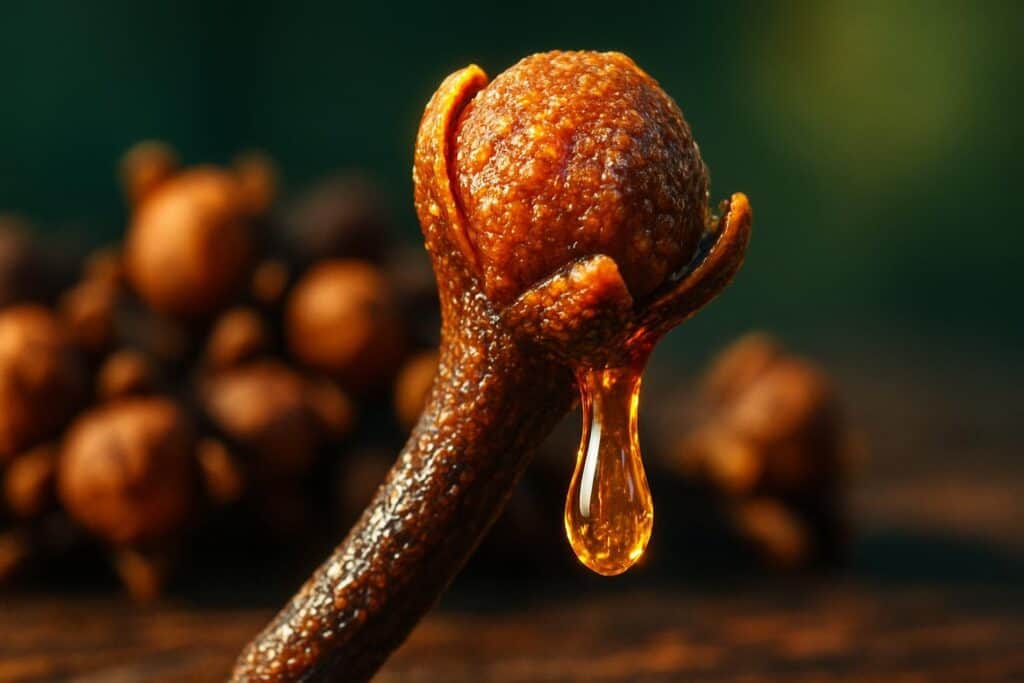
Clove essential oil is 70–90% a single phenolic compound — eugenol donates one hydrogen atom to neutralize a free radical, and the threat stops there.
The clove bud is, by mass, mostly one molecule. Eugenol makes up 70–90% of clove essential oil, a concentration that puts it in a different category from nearly any other plant’s chemical defense. Most plants distribute defensive chemistry across dozens of compounds. The clove collapsed that strategy into one.
What eugenol does at the molecular level is specific. It carries a phenolic hydroxyl group — a structure that can release a single hydrogen atom to a free radical, a reactive molecule that would otherwise pull electrons from surrounding tissue and trigger a damaging chain reaction. Once eugenol donates that hydrogen, the radical stabilizes. The eugenol molecule absorbs the disruption and becomes something chemically inert instead.
How Eugenol’s Phenolic Structure Enables Hydrogen Donation
Eugenol is classified as a phenolic allylbenzene, formally 4-allyl-2-methoxyphenol. The key feature is its phenolic –OH group. Free radicals are electron-hungry. Eugenol’s –OH releases hydrogen to the radical, satisfying that demand without setting off further reactions. Research also documents that eugenol can interfere with lipid peroxidation chain reactions by trapping active oxygen species, and can be metabolized to dimers that further inhibit lipid peroxidation.
What the 70–90% Concentration Actually Means for Plant Defense
Most phytochemical surveys find eugenol at 70–90% of the essential oil by mass in clove buds. That is not diversification — it is saturation. The bud essentially becomes a reservoir of one defensive molecule, present in high enough concentration to intercept oxidative threats across the tissue. Botanists still debate why the clove committed so completely to a single compound while related plants spread their bets. One answer the chemistry supports: eugenol is genuinely effective across multiple threat types, showing documented antioxidant, antimicrobial, and anti-inflammatory activity.
Closing
The clove bud offers a clean example of radical simplicity as a biological strategy — not a metaphor, a mechanism. One molecule, saturating the tissue, donating hydrogen atoms until the threat is gone. The most concentrated single-compound defense in a common kitchen spice turns out to be one of the better-understood antioxidant mechanisms in plant chemistry.
Frequently Asked Questions
What is eugenol made of?
Eugenol is a phenolic allylbenzene, specifically 4-allyl-2-methoxyphenol, with a phenolic hydroxyl group responsible for its antioxidant activity.
How does eugenol neutralize free radicals?
The phenolic –OH group donates a single hydrogen atom to a free radical, stabilizing it and stopping the oxidative chain reaction without producing a new reactive species.
How much eugenol is in clove essential oil?
Phytochemical surveys consistently place eugenol at 70–90% of clove essential oil by mass, making it the dominant constituent by a wide margin.
Does eugenol have other defensive roles beyond antioxidant activity?
Yes — documented activity includes antimicrobial and anti-inflammatory effects, and eugenol metabolites have also been shown to inhibit lipid peroxidation chain reactions.