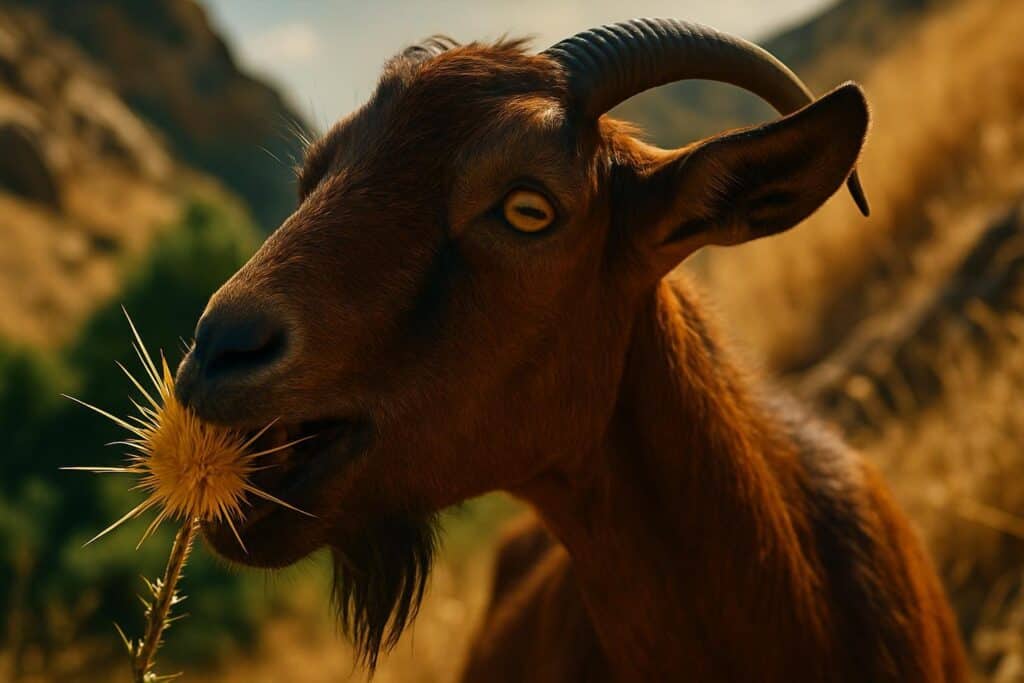
400 goats and sheep cleared 180 acres of yellow star-thistle in 8 weeks — on slopes no machine can reach, the goat is the only tool that fits.
Targeted grazing by goats is a documented wildfire fuel reduction method used by California counties and conservation districts to remove dry invasive vegetation from terrain that machines cannot safely access. The Sierra Resource Conservation District and the City of Fresno deployed roughly 400 goats and sheep across 180 acres overtaken by yellow star-thistle, scheduling the program for about eight weeks before restoration crews began replanting native grasses and shrubs.
That scale matters. Yellow star-thistle crowds out native vegetation and dries into dense, highly flammable mats. When it dominates a steep hillside, it doesn’t just burn — it burns intensely.
How Goats Interrupt the Yellow Star-Thistle Reproductive Cycle
A goat eating a thistle flower is doing something a mower cannot. According to Sierra RCD’s rangeland manager, goats and sheep consume the spiny flowers and seed heads of yellow star-thistle before those seeds ripen and drop. Seed-head removal stops the plant’s regeneration entirely. No seed dispersal means no new seedlings the following season, and over multiple grazing cycles, the soil seed bank gradually depletes. That opens the ground for native grass restoration work to actually hold.
Mowing cuts stems at a fixed height and leaves seed heads intact if timing is off. Goats remove the reproductive structure directly.
Why Steep Terrain Makes Goats the Only Practical Option
Santa Clara County uses goats specifically where cattle cannot roam and where the terrain defeats mechanical equipment. At Grant Lake, goats work 26 acres near a creek corridor to clear poison hemlock, yellow star-thistle, and teasel. Along the Coyote Creek Trail, separate herds graze up to 63 acres targeting serious yellow star-thistle infestations.
Those are not sites where a mower could substitute. Rocky hillsides and dam faces require an animal that navigates uneven ground without mechanical risk — and that will eat the thorny plants cattle avoid. Goats also browse vertically, standing on their hind legs to strip leaves above ground level, which lowers fuel continuity in ways mowing misses entirely.
Closing
Prescribed goat grazing is not a replacement for the full toolkit — the Fresno project hands the land back to restoration crews once the animals finish. But on the acres where machines stall and herbicides scatter, the goat is filling a gap that nothing else closes as cleanly. The animal is just hungry. The outcome is a hillside that burns less easily next summer.
Frequently Asked Questions
Does goat grazing actually reduce wildfire risk?
California counties and conservation districts use it explicitly for that purpose, targeting dry invasive plants that increase fuel load and fire intensity potential.
How long does a goat grazing program typically run?
The Fresno project was scheduled for approximately eight weeks across 180 acres before active native replanting began.
Can goats control yellow star-thistle long-term?
Repeated grazing timed to remove seed heads depletes the soil seed bank over multiple seasons, but sustained results typically require follow-up restoration planting of native species.
Why are goats used instead of herbicides or mowing on steep slopes?
Goats access rocky, uneven terrain where equipment cannot safely operate, and Santa Clara County uses them precisely where mechanical and chemical methods are impractical or carry unacceptable off-target risk.