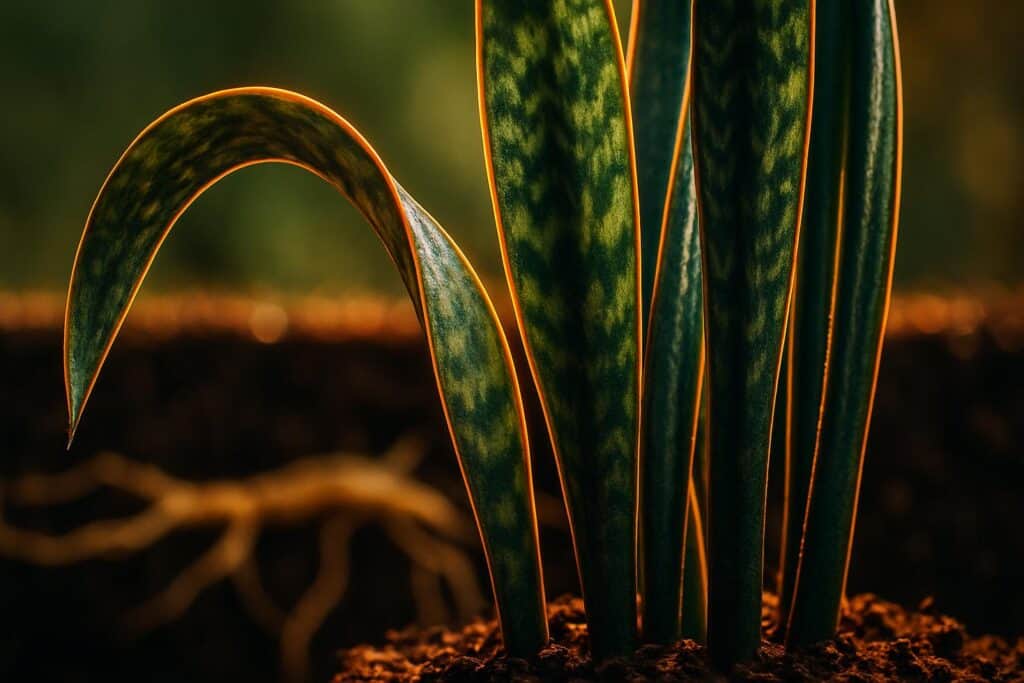
A bent snake plant leaf still runs CAM photosynthesis through the night — feeding a rhizome that survives 2–3 weeks of complete darkness on stored starch. The leaf was never the real plant.
A bent snake plant leaf does not stop working. As long as the tissue stays green, it keeps running Crassulacean Acid Metabolism — opening its stomata after sunset, pulling in CO₂, and converting stored acids into sugar by day. That chemistry continues whether the leaf stands upright or folds at a hard crease.
The real surprise is where that energy goes. Every snake plant leaf connects directly to the rhizome, a fleshy horizontal stem at or just below the soil surface. That rhizome is the plant’s actual storage organ — accumulating starch over weeks and months, powering new leaf growth, and carrying the plant through drought or darkness.
How CAM Photosynthesis Keeps a Damaged Leaf Running
Most plants open their stomata during the day, which costs water to heat. Snake plants invert that schedule. Stomata stay closed through daylight hours and open only after dark, when temperatures drop and evaporation slows.
CO₂ absorbed overnight gets stored as organic acids. Daytime light then converts those acids back into sugars, with stomata sealed the whole time. A bent leaf with intact chlorophyll runs this cycle just as a straight leaf does — the crease changes the leaf’s angle, not its biochemistry.
Blooming Expert notes that snake plant leaves are permanent structures. A leaf that bends or gets partially cut stays in the pot indefinitely, continues photosynthesizing, and never regrows from the damage point. The plant does not abandon it.
The Rhizome’s Role as a Long-Term Starch Reserve
The rhizome is where months of photosynthetic output actually accumulate. Under normal conditions, non-flowering cultivars direct metabolic resources toward rhizome expansion and leaf thickening rather than seed production. The result is a steadily deepening starch reserve.
That reserve has a measurable stress window. The Homesprouts reports that rhizomes sustain basal metabolism for 2–3 weeks in complete darkness before starch depletion leads to irreversible leaf senescence. During that window, no functional leaves are required — the plant runs entirely on what it banked underground.
Even in dim indoor corners at 50–80 foot-candles, a surviving bent leaf contributes to that reserve. Fifteen to twenty percent photosynthesis capacity is not dramatic, but it extends the window and slows the drawdown.
Closing
What looks like a damaged plant is often a plant in maintenance mode — running its chemistry quietly, drawing on reserves built over months. The bent leaf is still part of that network, not a casualty of it.
The crease is permanent. The work is not.
Frequently Asked Questions
Does a bent snake plant leaf still photosynthesize?
Yes. A bent leaf with intact green tissue continues CAM photosynthesis — opening stomata at night to absorb CO₂ and converting stored acids into sugars during the day.
How long can a snake plant survive with no light at all?
Rhizome starch reserves sustain the plant for 2–3 weeks in complete darkness before depletion causes irreversible leaf senescence.
What is a snake plant rhizome?
It is a fleshy horizontal stem at or just below the soil surface that stores water and carbohydrates, generates all new leaves, and acts as the plant’s primary long-term energy reserve.
Will a bent snake plant leaf ever straighten again?
No. A bent or broken leaf forms a permanent crease and will not straighten. It can be removed for aesthetics or left in place, where it continues to function physiologically.