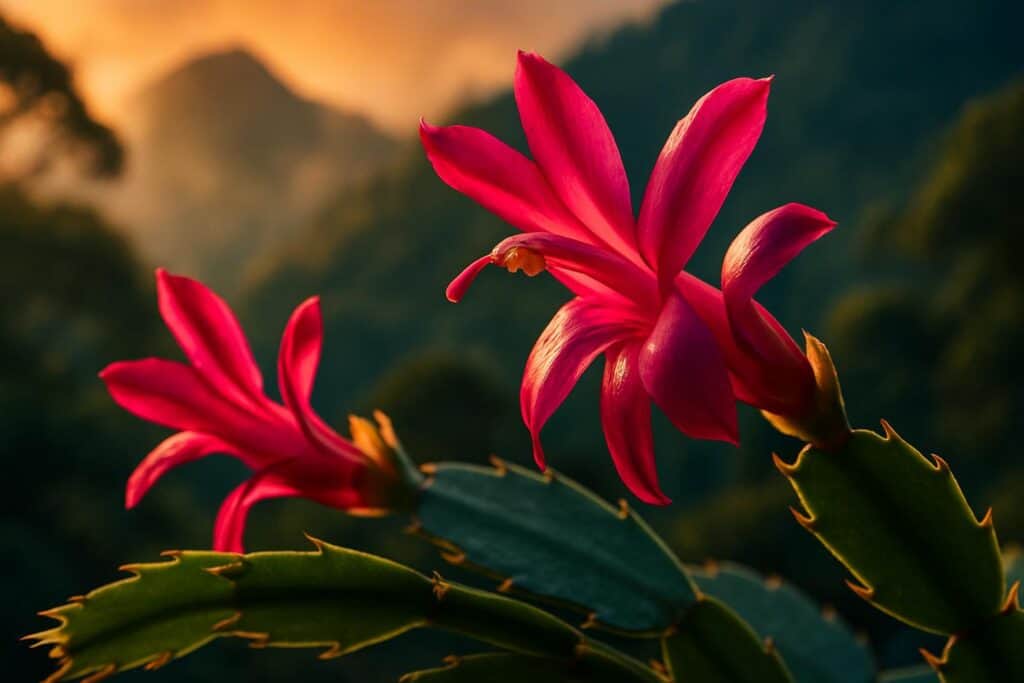
13–15 hours of unbroken darkness, night after night for 6–8 weeks — and one stray beam of light can erase the whole countdown. That’s not a quirk. That’s a forest shadow clock.
Christmas cactus (Schlumbergera spp.) is a short-day plant native to the shaded, humid Atlantic coastal mountain forests of southeastern Brazil — not a desert. That origin is the key to everything about how it flowers. It evolved under a tree canopy that delivered filtered light by day and genuine, uninterrupted darkness by night, with autumn bringing longer and longer dark periods as the Southern Hemisphere season turned.
Inside the plant, a photoreceptor protein called phytochrome measures the length of each unbroken dark period. When nights run long enough, consistently, that signal triggers a hormonal cascade that converts vegetative meristems — the growth points that had been producing stems and leaves — into floral primordia, the structures that become buds. The process is biological, not intentional, but it is exquisitely calibrated to a world without electric light.
Why the Brazilian Forest Habitat Explains the Darkness Requirement
In southeastern Brazil’s Atlantic coastal forests, Christmas cactus grows epiphytically on trees and rocks under dense canopy. Daytime light is bright but diffuse. Autumn nights are both long and cool, dropping to temperatures that horticultural sources place in the 55–65°F range.
That specific combination — extended darkness plus mild cool — is what the plant’s photoperiod system is tuned to detect. Extension guidance from Michigan State University specifies 13 or more hours of continuous darkness daily, beginning in late September or early October, sustained for about eight weeks. This is not an approximation; it reflects the actual autumn night lengths the plant’s ancestors experienced in its native range.
How Phytochrome Converts Darkness Into Flower Buds
Phytochrome exists in two interconvertible forms. Daylight, rich in red wavelengths, drives the protein toward its active form. Darkness causes the active form to decay back toward its inactive state. In a short-day plant like Christmas cactus, it is the accumulation of that decay — across an uninterrupted dark period exceeding the critical threshold — that modifies gene expression in the shoot apical meristem.
Once the signal accumulates over 6–8 weeks of qualifying nights, the meristem stops producing vegetative tissue and begins producing floral primordia. A single flash of light during the dark window resets the phytochrome ratio and interrupts the countdown. Michigan State University Extension explicitly notes that even a brief light interruption can cause bud drop.
Closing
The bloom of a Christmas cactus is the endpoint of a six-to-eight-week chemical accumulation, run by a protein that has been measuring darkness in Brazilian forests for millions of years. Given the right conditions — 12–15 hours of unbroken dark, nights between 55–65°F, starting in early October — the meristem shift follows as reliably as the season itself.
The plant doesn’t know it’s December. It just knows the dark finally ran long enough.
Frequently Asked Questions
How many hours of darkness does a Christmas cactus actually need?
Most horticultural and extension sources specify 12–15 hours of complete, uninterrupted darkness per night, with Michigan State University Extension centering guidance at 13 or more hours.
How long does the dark treatment need to last?
The dark period must be sustained for 6–8 weeks, beginning in late September or early October, for buds to initiate in time for holiday flowering.
Can a brief light exposure really stop bud formation?
Yes. Michigan State University Extension and Epic Gardening both document that even brief light interruptions during the dark period can cause bud failure or drop.
Does temperature matter alongside the dark period?
It does. Night temperatures above 70°F (21°C) can inhibit bud development even when darkness requirements are met; the effective range is 55–65°F (13–18°C) at night.